

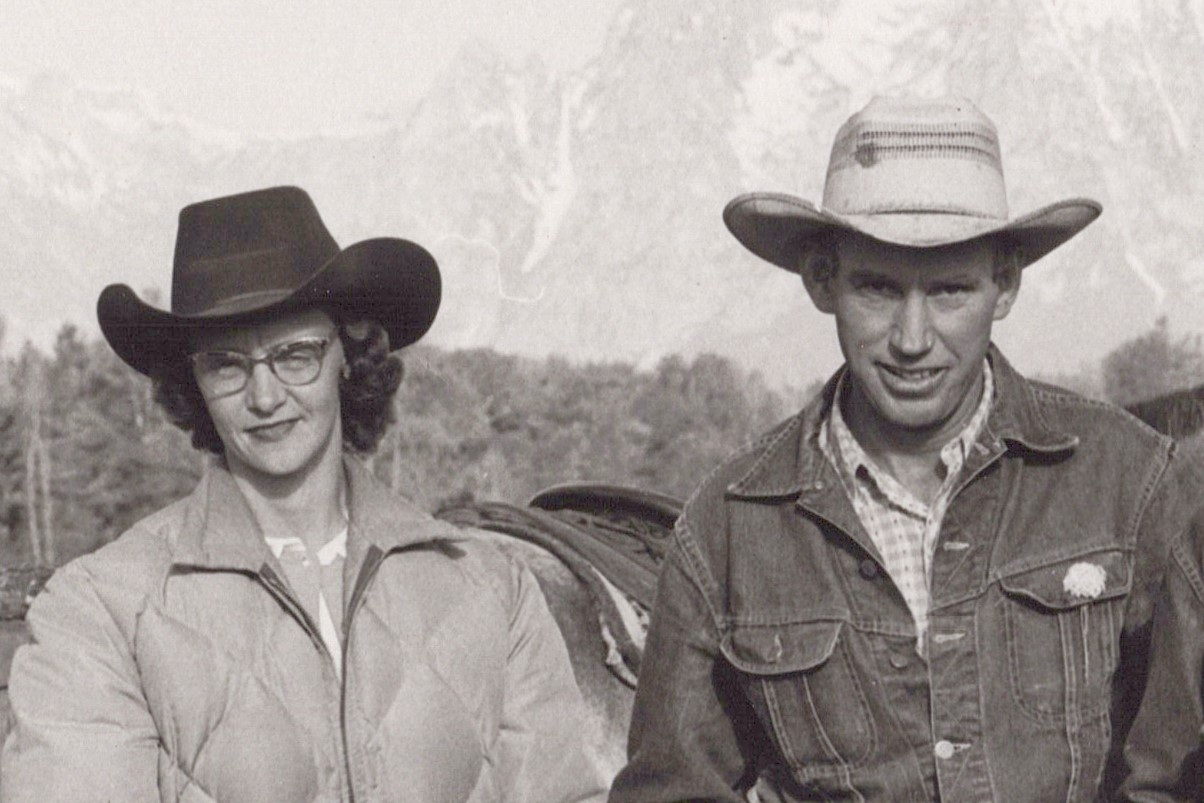
Warren M. Robertson was born in January 1923 to James and Beth Robertson in Jackson. His grandparents and great uncles and great aunts were some of the earliest settlers in the Jackson Hole valley.
Warren was raised on his parents’ ranch south of town until the ranch was lost due to the Depression in the early 1930s. His parents moved into the town of Jackson but rented some acreage where they could have cows and horses. Warren and his brother Orland used the old work team to do odd jobs around town such as plowing gardens and hauling trash.
During his high school years, he boarded with and worked for his Great Uncle George Wilson, getting up at 5 a.m. to milk cows and take the horses to water before going to school and then helping feed after his return in the afternoon. He was paid 25 cents a day on school days and $1 a day on weekends.
After graduation from high school in 1942, he went to work for the Moseley Land and Cattle Company. Warren always liked good cattle and quality horses and had a great desire to be an expert cowboy. He herded cattle on the summer range and helped winter 1,200 head of cattle at the Elk Ranch south of the Moran junction in 1943.
In the spring of 1944, he enlisted in the Navy with his best buddy because as he said, “he did not want to do a lot of marching.” He served mostly in the South Pacific until his honorable discharge in January of 1946.
After returning home, he once again went to work for Major Moseley and herded cattle that summer at the head of the Gros Ventre. In the fall of that year, deciding he wanted to see how they cowboyed down south, he went to southern Arizona where he spent the winter breaking colts. He enjoyed working alongside these Mexican cowboys and said he learned a great deal during this time. Before there was anyone called a “horse whisperer,” Warren patiently worked with colts to engender trust, establishing a lifelong pattern of firm and steady guidance for animals and people alike.
Warren rode some of the best cow horses, and contrary to the old cowboy tale that geldings are better, he preferred to ride mares. He had many special horses, but perhaps the most memorable to him were Topsy and Lady. Together with Warren, they worked cattle and regularly went to rodeos and ropings.
From 1947 to 1950 Warren hired out on various ranches including the Moseley Land and Cattle Company, the Hansen ranch, the Jim Imeson ranch and in the summer of 1948, he herded cattle for the Fish Creek Cattlemen’s Association. This summer range covered about 5,700 acres and extended from the top of Togwotee Pass south into the Gros Ventre area. Four ranchers with a total of about 1,700 head of cattle sent 17 horses for riding and packing salt. These ranchers must have had great confidence in this young cowboy as they only hired Warren for the summer, but he said he got paid a good wage so he was satisfied.
In high school Warren had become good friends with Earl and Howard Hardeman. Their parents, Gerrit and LaMar, had homesteaded north of Kelly, in the early 1920s and had a purebred Hereford cattle ranch. Gerrit had emigrated from Holland in 1910 at the age of 18. He had friends who lived in the Jackson Hole area and soon found himself working as a teamster. LaMar’s parents, the Crandalls, owned a roadhouse at the foot of Teton Pass and Gerrit and LaMar met there. They married in 1922 and had four children: Earl, Marie (Stilson), Howard and Helen. (Earl was inducted into the Wyoming Cowboy Hall of Fame in 2018.)
The four Hardeman children rode horseback to the elementary school in Kelly, approximately three miles away. It has been calculated that they each rode approximately 10,000 miles to complete an eighth-grade education. Their father always insisted they ride bareback because he thought it both warmer and safer.
LaMar was a wonderful cook and Warren was a frequent visitor to their home in Kelly. It was there that he became acquainted with Helen and they fell in love.
In March of 1950, Warren and Helen married. Having been raised on a ranch herself, Helen was an essential part of his work from the beginning and his partner in every undertaking. They were married for over 63 years and raised three children: Irene Steeg, Gene Robertson, and Lois Shaffer. They were devoted grandparents to seven grandchildren, and are also survived by nine great-grandchildren.
Warren started working for Bruce Porter who owned the Jackson Hole Hereford ranch south of Jackson in 1950 and, apart from a short hiatus, worked there for more than 40 years as ranch foreman. Laboring alongside other hard-working men on the ranch, they built a good herd of Hereford cattle and had one of the best haying operations in the valley.
Following a prototype believed to have originated from Montana, Warren and co-workers built a 26-foot-high beaver slide that enabled the production of between 90-100 haystacks each summer. Eventually two side stops and a backstop were added to the operation. The raked hay was gathered from the field with the use of motorized buck rakes and lifted into the hay bin with a 22-foot-wide fork powered by a mechanical winch. It was Warren’s job to run the winch and he was an expert in layering the hay into the haystack crib so that manual labor was only needed to finish the top. This stored feed was enough to winter about 800 head of cattle.
During haying season, Helen prepared lunch for hay crews of 8-10 hungry workers in the mornings. It was her nature to work fast, so after the meal she could have the dishes done and be in the hayfield by early afternoon. Her presence enabled the use of three buck rakes to be in operation. Warren and Helen’s son, Gene, drove one of these, and often there was a competition to see who could most quickly collect the hay from the raked windrows and be the first to deliver the small mountain of hay to the beaver slide fork. Helen was always a tease and this contest helped break up the monotony of this haying work.
Ranch work has a seasonal rhythm to it. Winter involved feeding cattle on snowy fields in every kind of weather. The cribbed hay was forked onto horse drawn sleighs or wagons, and then hand pitched off to the awaiting hungry cattle. Spring was calving which was six weeks of day and night obstetric care. Early May was branding and vaccinating those new calves. Warren did every branding job, but dehorning was his specialty. Neighbors helped one another and branding turned into social events that tied the ranching community together.
Soon after branding, hundreds of head of cows and calves were trailed by horseback from South Park (south of Jackson) north to the Elk Ranch, near to the northern entrance to Grand Teton National Park, almost 30 miles. This took four or five exceptionally long days and every available cowboy. Warren invariably had a good cow dog to make this work easier.
Although Helen did not usually ride horseback during this cattle drive, she produced the most delicious meals and delivered them to the hungry cowboys along the trail. She was well-known for her wonderful homemade bread, rolls, and pies.
In the fall, the cattle had to be returned home from this summer range. Because the Elk Ranch pastures were shared with other ranches, the cattle had to be gathered, separated according to brand, and trailed back to their respective homes. Warren was routinely tasked with the job of cutting mama cow-calf pairs to the right group.
Horses were rarely ridden for pleasure but they did get a change of pace with weekly attendance at the local rodeos. Warren was an avid calf roper, team roper, and worked as a pick-up man for the bronc riders at the local rodeo for a number of years. When the annual cutter races were held to support the Shriners’ work, Warren rode to ensure any runaways with the cutter teams were curtailed.
As the saying goes, “being a cowboy is not for sissies,” and Warren incurred numerous injuries including a broken neck when his cinch broke while roping in a rodeo. By the grace of God, he walked out of that arena to be taken to the hospital. He spent months in a partial body cast to heal. Being gored by a bull and having a spread pelvis were among his injuries. Helen devotedly nursed him through all these times of recovery. Despite all this, in his old age he rarely complained of pain, and then only of aching thumbs.
Warren and Helen were a team and exemplified what a true cowboy represents: devoted to family, honest, hardworking, diligent and careful caretakers of the animals entrusted to their care, with a quiet faith in a loving God. Warren observed strict cowboy etiquette especially with regard to his cowboy hat, and always let a lady of any age precede him through a doorway.
Both Warren and Helen lived to the age of 90. Warren died in Worland, in October of 2013 and Helen died in Jackson, in November of 2022. They are buried in the Elliot Cemetery in Wilson, Wyoming.