

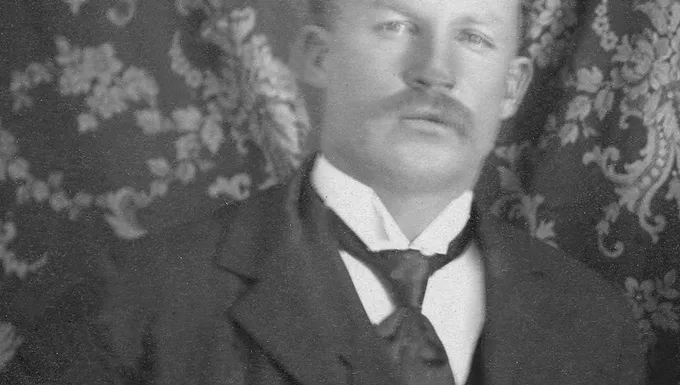
Stanley G. Murdock was born in Heber, Utah on July 11, 1865. He was the son of Joseph Stacy Murdock, one of the first Mormon bishops of the Wasatch Stake. Stanley’s mother, Jane Sharp Murdock, had come to America from Glasgow, Scotland. Stanley was the sixth child in a family of nine children. As a teenage lad, Stanley hired on with Texas cattle drives and guided a herd of several hundred Texas cattle through Utah into Wyoming.
In 1883, when Stanley was 18 years old, Rody Thornton hired him to help trail a herd of cattle from Utah to LaBarge where Thornton ranched. Stanley worked for Thornton for the next 13 years as foreman and ranch hand. He had charge of the cattle, gained knowledge and experience in the ranching business, and spent a lot of time breaking horses.
Stanley took most of his pay in calves at branding time so by the time he went into ranching on his own, he had built a herd. Along with Lafe Griffin and Frank Robbins, he gathered horses off the desert east of the Murdock ranch, which is at the fork of the river where New Fork and Green River join. He broke and sold those horses to make extra money. He also began to raise fine horses, bringing good blooded horses in to his herd. He branded his horses on the left thigh with the Four Bar or Pigpen brand. Later he sold his horses to James Barrett in Green River and sold the brand as well. However, rounding up all the horses on the desert proved to be nearly impossible and some were left. For several years, ranchers would see Four Bar horses on the desert.
Stanley Murdock and Mary Solon were married in Larchwood, Iowa, on February 15, 1906. They had four children, who were Solon born February 22, 1908, Caryn Bing born July 27, 1909, Joe on July 28, 1912, and Pat Schmitz joined the family on July 31, 1916. On October 12, 1916, Stanley Murdock died leaving Mary with four small children.
A History of Stanley Murdock
By Charles J. Bayer circa 1920s
In 1892, Stan Murdock helped Rody Thornton trail about 600 head of cattle into the area between LaBarge and Eden Valley, occupied the range, and bought what is known as the Figure Four Ranch on Dry Piney. He immediately cleared off some land and put it into hay meadow, so he was soon able to feed some of his weaker animals during the coldest parts of the winter.
Stan Murdock was kept busy riding and breaking horses the year around. Stan directed the ranch work besides having complete charge of the cattle. Thornton took it easy around the ranch except when Stan needed help to move or work the cattle. If anyone came by and wanted to borrow a horse or anything else, Thornton would say, “I mean to say, you will have to see Stan.” And, that was the law as far as he was concerned. Neighbors soon learned there was no use to ask Thornton anything and would look up Stan.
About July 1895, Stan had all the calves branded and driven up on the summer range in the vicinity of the Hogsback and the head of Dry Piney. One day while cowboying around the north end of the Hogsback, Stan spotted a bunch of horses and decided now was the time to catch and break broncos that would make good saddle horses. There were about ten head in the band, and at that time of the year, they were fat and sulky. If he could manage to get them down on Poverty Flats, below the Badlands, with good luck, he might be able to corral them.
It so happened that I was ten years old and happened to be along the wagon road that led up the river when here came a bunch of horses on the run and Stan not far behind. About this time, the leader of the bunch decided they were making a mistake and made a wild dash to get back to the Badlands. Stan was on the alert and took the exact part he would have to play to outwit the old mare. He knew that he must make a hard and fast run while at the same time having to stay at least a hundred yards from them, or they would scatter and run around him. He had them headed toward the Big Wash. He knew they could not cross unless they hit the wagon road crossing into which Stan did not plan to head them. The old mare knew, too, that this wash was impassable, but she thought she could gain enough ground to get around Stan before he could head her off. She was right and would have gotten by ok, but that split moment, Stan had a slight edge over her when his six-gun started to talk–pop-pop-pop. A fog of dust was thrown up about ten feet in front of her, which stopped her so quick she almost fell over backwards. She turned around with the rest of the bunch, which swapped ends as fast as they could. They were so suddenly surprised that from then on they lost the battle of escape. Stan kept a close eye on the leader because if she saw the slightest chance, she would take it and try again. They were all about out of breath, but Stan knew if he kept them going they would go into the corral without too much trouble. Stan and his horse were right on the bit and ready for any emergency that might pop up.
While I was not old enough to be a cowboy, I had ridden around some, wrangled and milked the cows. From 1890 to 1898, nearly all the cowboys stopped for dinner, to stay overnight, or to warm up and to melt the icicles off their mustaches during the cold winter weather.
Those were days when cowboys were men, and to my mind, Stan was at the top of the list. When Stan decided to break a bronco, he just put him between his knees and rode him, whether the horse liked it or not. Stan always owned and broke his own horses. He rode the best horses to be had. I always assumed that Stan was mostly paid in taking calves at branding time from Mr. Thornton. When he went to ranching for himself, he had his herd made.
Stan and I used to meet occasionally all the years up to 1910, and then I was transferred from Kendall to Lander as the Forest Ranger. From 1906 to 1910 while I was Ranger at Kendall, the cattle needed stock salt to keep them from tearing pack outfits to eat bacon and ham whenever they could find such. When the Forest Service suggested putting salt on the range, Stan was the first to agree that it should be done. A couple of the other permittees said it wasn’t any of the Government’s business whether they furnished salt or not. Therefore, I say Stan Murdock was a real rancher and livestock producer.