

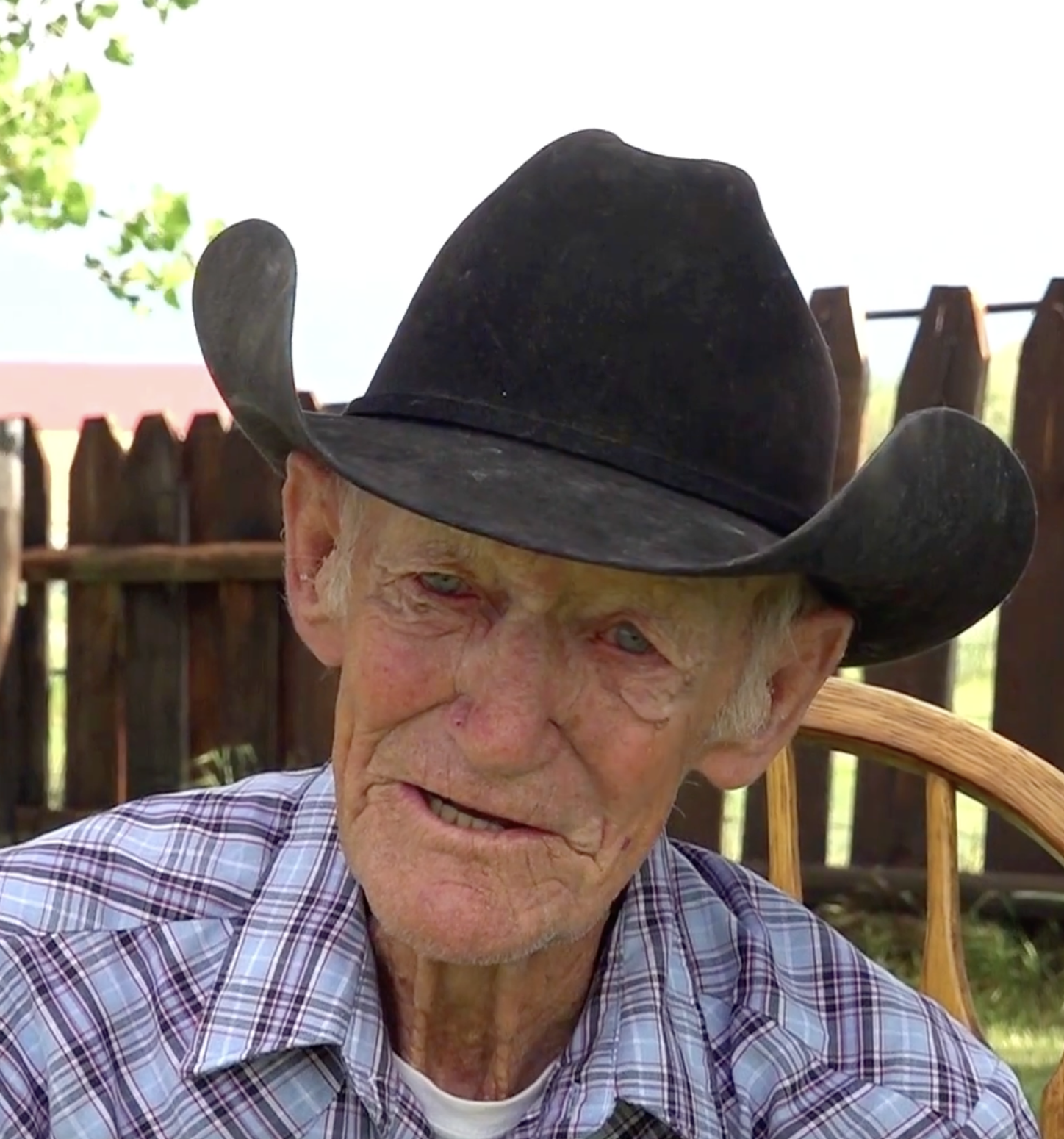
Sonny Jarrard was born in Midwest, Wyoming, on September 26, 1940. He was the first child born to parents Harold and Katherine Jarrard. As an infant, he lived on the old Martin Frewen Ranch on the Powder River owned by his parents. Growing up the oldest child and son, he had no choice but to be a cowboy.
As soon as he was able to walk and follow his dad, he had a rope in his hand, wanting to be a cowboy. There were times his mother would put a harness on him and hook him to the clothesline because he insisted on following his father, and with three other younger sons to take care of, that was her only option. Releasing Sonny from the clothesline became a problem when Sonny’s dog decided to protect him from his mother. Sonny would stay hooked to the clothesline until his father came home.
As Sonny got older, he became his father’s right-hand man as Harold worked on many ranches around Wyoming. When he was ten years old, a neighbor about three miles down the road told Sonny he could have a wild colt if he could get him home, even at this young age, Sonny accepted the challenge. He used two long ropes and went from one fence post to the next until he got home.
After Sonny’s parents were divorced, Harold went to work at the J E Ranch in the Rattlesnake Mountains. Sonny and his young brother, Dick, moved there with Harold. These years were hard for Sonny. He broke his leg and required a full-body cast. His younger brother Dick would pull him to school on a toboggan sled. Dick would walk and trot his horse until the top of the hill and out of sight of his dad. As soon as he was out of sight, he would kick his horse into a full gallop for a wild ride.
These experiences as a young boy on a big ranch cemented Sonny’s desire to become a cowboy. Sonny’s first job was taking care of extra horses on the summer roundup. Sonny was not allowed to carry a rope on his saddle, as his dad knew he would not pass up the temptation to try to rope a wild horse.
Sonny was 15 when Harold moved back to the ranch on Powder River in Kaycee. Sonny started school in Kaycee. This required him to ride a horse five miles into town along the county road. Harold thought, what better way to get his young horses broke to ride than to have Sonny make the ten-mile trip on them. Early mornings were spent on the flat in front of their house, getting Sonny lined out on a colt before school.
Going to high school was not fun for Sonny. When he turned 16, he quit going to school and left Kaycee. He went back to the Sweetwater country of Wyoming and went to work for Ben Roberts on the Bug Ranch. While working on this ranch, he was probably one of the last cowboys to experience trailing cattle into the little town of Powder River. The ranches trailed the cattle to Powder River and loaded them onto the trains to be sold in the eastern markets.
Sonny worked for about four years on the Bug for Ben Roberts. He took care of the horses, and soon, for 25 extra dollars a month, he started riding the rough string. This job required him to ride and train the horses that no one else wanted to ride, and this is where Sonny developed his desire to work with broncs and turn them into horses people could enjoy riding.
Sonny was lucky to work on ranches that still used teams and wagons. They rounded up cattle, branded calves, and shipped the cattle. This was a time before four-wheel drive pickups, horse trailers, or four-wheelers and motorcycles were used to gather cattle. The range was still open as many ranchers shared the range.
After Sonny’s time working at the Bug Ranch ended, he went into basic Army training and remained in the Army reserve for seven years. After basic training, he moved back to Kaycee. He went to work for Blue Creek Ranch, west of Kaycee, at the foot of the Bighorn Mountains. About 1959, while working for the Blue Creek Ranch, Sonny was snowed in on the Dry V Slope part of the Blue Creek Ranch that sits between Eagle Creek and Buffalo Creek in the Hole in the Wall country. They moved the cows to Dry V in November, and the grass was good. They had an old oil field tank full of cottonseed cake to feed the cows if needed. Mrs. Taylor, the ranch owner, provided a pickup for Sonny to drive when he needed to return to the main ranch. A snowstorm blew in shortly after the cows were turned loose on the Dry V. Sonny and the cows were stranded on the slope. As the snow was too deep, the pickup was of no use.
Sonny was able to feed the cows the cake by stacking 3-4 sacks on end and putting a rope around them, kicking his horse into a gallop, and scattering the cottonseed cake. Each day after feeding, Sonny would have to start the pump to provide water for the cows.
Sonny would say that his only company on Dry V was the mice in the cabin. The weather got better, and he was able to ride a horse to the main ranch in April. Sonny worked for Blue Creek and Mrs. Taylor off and on for many years. Sonny also helped neighboring ranches gather cattle off the slopes of the Big Horn Mountains. The ranchers prepared a herd to be trailed to the shipping corrals in Arminto, Wyoming. At these corrals, the cattle were loaded on train cars and shipped to eastern markets.
Times were hard, and a rancher challenged Sonny to ride a bunch of broncs from Buffalo to Buffalo Creek, a distance of about 60 miles. The owner of the colts told Sonny that if he rode them to Buffalo Creek, he would pay him. Sonny tied the broncs together by the head of one to the tail of another as he rode one and drove the others. After many wrecks and mix-ups, he finally made it to the TTT Ranch south of Kaycee. The broncs were exhausted and could go no further A truck was sent to haul them to Buffalo Creek.
Sonny spent a lot of time doing day work for various ranches in Johnson County while breaking horses for other ranchers.
Times were still hard for Sonny. He went back to the Sweetwater country and worked for a while.
Around 1970, Sonny decided to move to California. Fritz Nosler hired him. Fritz owned ranches in Likely, California. He also bought a ranch in Riley, Oregon. Sonny went to the Riley Oregon Ranch, where he cared for 500 head of cows. Grass was short on this ranch. A neighboring ranch grew potatoes. Sonny had an old friend working on Silver Creek Ranch. Sonny was able to purchase the cull potatoes, which he fed to the cows. The cows gained weight and got fat. Fritz was pleased when he saw his cows.
The next job Sonny had in California was as a ranch manager for Sage Creek Ranch in Burney This ranch was owned by a group of investors from Los Angeles. This ranch ran about 500 head of cows plus farmland raising hay to feed the cows. Sonny worked on this ranch for a couple of years until the ranch was sold.
Sonny decided to move to Fallon, Nevada. Fritz Nosler owned a sale barn in Fallon. While in Fallon, Sonny trained, bought, and sold horses. He would also do day work for ranches around Fallon. One time, a cattle truck headed to Austin, Nevada, on Highway 50 tipped over near Cole Springs. The brand inspector hired Sonny to gather the cows that survived the wreck and had scattered through the countryside. Sonny gathered one more cow than the brand people had listed. The brand inspector was in a dither. It turned out they had miscounted as they were loaded onto the truck.
Sonny would come back to Wyoming to help his father during the summers, sometimes trailing cattle up the 33-mile trail to Chitum Springs in the Bighorn Mountains for his brother, Roy Jarrard.
In 1981, Sonny had enough money saved to buy a little bunch of cows and to lease a ranch. He moved to Canyon Creek in Natrona County. The winter of 1983-1984 was a tough one on this ranch. Sonny had kept most of his calves as the prices were low, and the ranch had a good supply of grass for the cattle. This winter was one for the record books as there was deep snow and freezing cold. The loss of livestock in the Pedro Mountains was historic.
Sonny’s next move was to Mesquite, Nevada, so his wife, Sue, could finish her education to become a teacher. Sonny trained horses, put on team roping jackpots, and put on cattle penning contests in Mesquite, Nevada, Cedar City, and Monroe, Utah.
In 1990, Sonny moved back to Kaycee and went to work for Kaycee Land and Livestock. Kaycee Land and Cattle owned three ranches that ran between 250-300 head of cows year-round. One ranch was on the Middle Fork of the Powder River. The second was on the North Fork of the Powder River. The third ranch straddled the Johnson/Natrona County line on Tisdale Mountain.
Cows were calved in March on North Fork Ranch. In late May, all the cows crossed the Middle Fork River to get ready for the trail to the Tisdale Mountain Ranch in the first part of June. This was a 20-mile trail. The cows would summer up there until about the end of September. In October, cows were worked and calves shipped. This was the yearly routine for about 25 years until retirement. Sonny was responsible for putting up hay to feed the cows.
Sonny’s cowboy experiences occurred before the modern conveniences like four-wheelers, motorcycles, and ATVs. He lived in the generation of the true cowboy. Sonny was fortunate to be able to live his dreams of the life he had as a child as he followed his dad day after day. He still has a few cows on his place in Kaycee.