


 Dianne Boroff: Dianne Roberts Boroff was born March 10, 1951, to Dick and Leona Roberts and raised on the family ranch on Horse Creek near Merna, Wyoming. She grew up alongside her siblings Dru, Louis, Jenny, Zac, and D’Lisa, immersed from a very young age in the daily work of a Wyoming ranching family. Her parents ran a cow-calf operation, and her father also operated an outfitting business. While Dianne had little interest in the outfitting side of the business, she was drawn early and completely to horseback work and cowboying.
Dianne began riding and helping horseback as soon as she was physically able. By the age of six she was already helping her father gather cattle. One early memory that stayed with her all her life occurred when her horse slipped on ice while helping bring in a cow, resulting in a broken leg and a six-week hospital stay in Jackson. Despite that setback, she always said six was “the perfect age — big enough to cowboy, but young enough you didn’t have to.”
As a child and teenager, Dianne spent countless hours horseback. She and her siblings started colts for Miller Land & Livestock, earning $50 per head — money they used to buy school clothes, boots, and hats. Starting horses was a regular part of their livelihood and upbringing.
Like most working cowboys of her era, Dianne learned from the ground up at brandings. She began as a “tar baby,” swabbing pine tar on freshly dehorned calves to keep flies away and stop bleeding – a messy job she tried to get out of. She soon progressed to wrestling calves and, by the age of 13 or 14, began roping at brandings. By 19, she was an established roper in the branding pen. At a time when very few women attended brandings — and none were roping in Sublette County branding pens — Dianne had earned her place.
Her horseback work extended year-round. Winters often meant long, cold rides to bring horses in from pasture, sometimes traveling three miles one way in subzero temperatures. She learned early how to manage livestock slowly and carefully, understanding that patience and stockmanship were as important as strength. This “slow and easy” approach became a hallmark of her work and one she later passed on to her daughters.
Dianne’s cowboy education was shaped not only by her immediate family but by neighbors throughout the Horse Creek Valley. She regularly helped the Thompson family, the Jewitt family, the Bain family, Lawrence Shaul at the Richardson place, and many others. Whether moving cattle, gathering horses, or handling day-to-day ranch work, Dianne was always willing to show up and stay until the job was done.
After marrying Max “Joe” Boroff in 1970, Dianne continued her life as a working cowboy. Together they managed the Richardson Ranch for seven years, handling the full scope of ranch operations. They later moved to and operated the Thompson Ranch for many years, eventually purchasing it from Joe’s parents. During this time, Dianne was regularly working in the saddle, managing cattle, doctoring livestock, and overseeing brandings and seasonal cattle moves.
When the Wagstaff family purchased the Richardson place, Dianne and Joe managed their cattle operation on top of their own for many years, including large summer pasture herds. Later, when Joe stepped back from that role, Dianne took over full responsibility alongside her daughter Mandy. For approximately five years, the two of them managed over 1,000 head of steers, largely on their own. When additional help was unavailable, Dianne rebuilt corrals herself and handled heavy work with a saw or axe as readily as she did horseback work.
Throughout her life, Dianne was known for knowing her cattle — their numbers, histories, and bloodlines — and for her calm, thoughtful stockmanship. She believed that letting animals figure things out “slow and easy” saved time and stress in the long run. Her daughters remember her often saying, “It might not be the cowboy way, but it’s our way.”
In addition to her horseback work, Dianne developed significant cowboy-supporting skills as a leatherworker and saddle maker. She spent a winter apprenticing with saddle maker Tom Colerick, learning the trade. She went on to build saddles, chaps, and especially chinks for ranchers throughout Sublette County and beyond. Her chinks were widely used in the Horse Creek Valley and became one of her signatures.
Dianne also embodied the values of a good neighbor and a true cowboy. She fed crews after long days, always had coffee on and a hot meal ready, and helped neighbors move cattle between Beaver and Big Piney well into her later years. Even after selling their ranch around 2013 and moving closer to Daniel, she continued to keep horses and help wherever she could.
Dianne Boroff spent her life horseback, working livestock, starting horses, managing ranches, mentoring younger hands, and serving her community. Her work ethic, humility, toughness, and generosity exemplify the true meaning of a Wyoming working cowboy.
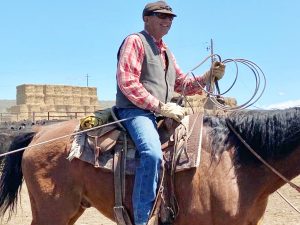 Louis Roberts: Louis was born January 3, 1953, to Dick and Leona (Osborn) Roberts. Louis had two older siblings, Dru and Dianne and three younger siblings Jenny, Zac, and Lisa. Louis grew up in the Horse Creek Valley in Merna. When Louis was in the 5th grade, the county decided to keep the road open, enabling the school bus to run up and down the county road all winter. Up until this time, Louis had attended country school in Merna with his siblings. Louis’s Aunt Phyllis Osborn was their teacher for many of the years.
During these early years, Louis spent his summers preparing for the long winter. Groceries were bought and stored in the fall to last until spring. Every day the kids got to pick a can of Campbell’s Soup for school lunch, often pairing it with corn bread. As an adult, Louis would not eat Campbell’s Soup or corn bread. When Louis was in the 5th grade and made his way to Pinedale to attend school, he remembered catching every pesky cold that came around. In high school, Louis played football and received a Letter. However, when hunting season started, Louis’ football career ended, as he would rather be in the mountains on his trusty steed, hunting.
Louis graduated high school from Pinedale, in 1971. Louis married Leisa Ann Young on March 1, 1974. Together they had two children, a girl, Rel and a boy, Lou, who were raised on the same ranch up Horse Creek that Louis grew up on.
Louis started riding horses with his siblings as a toddler. By the time he was four his confidence outgrew his abilities. Louis fell off his dad’s horse, Dutch, and broke his leg after Butch Bain’s branding. This was the first broken bone of more than a dozen. Most of the broken bones came from riding or falling off of horses. However, Louis fell off his horse plenty of times that did not result in injury. Louis and Dru would play cowboys and Indians riding bareback in the pasture. When they would shoot each other with a pretend bow and arrow or rifle, the one being shot would fall off the horse landing on the ground below.
Louis, Dianne, and Dru broke colts for Bobby Miller. At first, they got paid $50 a head. Later on, they would break three colts and then receive one colt they could keep. Louis, Dianne, and Dru pooled their money to buy one saddle for them to share. The saddle must have been worth its weight in gold because all of their younger siblings, their children and grandchildren have also had a turn in this saddle. Louis liked to ride the colts when they were bucking. Black Betty ended up being Kathy Miller’s horse. When they were breaking her, Louis would ride her because she would buck 12 times in a day.
To earn money the kids would day ride for Bains, Harold Thompson, Lawrence Shaul, and Jewetts. The kids would also fence with a wagon and team of horses, fixing fence for Millers and other neighbors. While fixing fence for Millers, seven-year-old Zac finished the Association Gate and shut it up tight. Sid Skiver said that the gate was too tight and he wanted women to be able to open and shut the gate. Zac and his siblings had to return to loosen up the gate, making it easier to close.
They would also move horses to and from Jackson with Dick. Dick was using the horses for outfitting. This took three days twice a year. It was a real adventure.
There was always work to be done and the kids discovered using horses lightened the load. The kids also broke teams of horses for fencing and feeding cows in the winter. Louis could hook up and drive three teams of horses to a wagon or sleigh always keeping his lines straight. However, as most would agree, he preferred to run one or two teams at a time. He at one time had a four-horse team of mules which he fed the elk on the feed ground up Horse Creek.
As young adults, Louis and Leisa would day ride for Bains, Larry Looney, and Harold Thompson until they could build up a herd of cattle of their own. They continued riding for neighbors throughout their lives. They found it was easier to work with one another than hire a crew for those big moves and brandings. Butch Bain would need help moving his cows to his upper place in the spring. The cattle were still calving and often you would see Louis riding with a very new baby calf draped over the front of his saddle as they pushed the cattle miles to better ground. When the cattle finally reached the upper place, Louis would return the young calf to its mom and the cow would be happy.
Louis would use horses to pack in hunting camps and later guide hunters. He learned how many square bales he could haul on a good stout mule, which was three. Louis loved hunting and used his horses to help him. One year he was able to kill a nice deer and a nice elk. Louis taught the love of working, ranching, riding, and hunting to his children and grandchildren.
As a rancher, Louis roped, branded, put up hay, fenced, and fed cows. Louis was always working on the ranch up until his death in 2021. Louis was fortunate enough to live his entire life working the ground he grew up on. He put up hay in the same fields 62 years in a row.
On horseback, Louis was a hand. Louis always had a great horse to ride because he trained them himself. Louis could read a cow and use that knowledge to guide her, making hard work a whole lot easier. Louis and Dru could rope and doctor the meanest of bulls on wide open range where there were no fences or corals to get in their way. Sometimes they roped other stuff too.
Louis was able to acquire a forest permit not far from his place (just through the fence). This allowed for even more time in the saddle because it spanned over 7000 acres. He would take the time to spread the cattle out and then ride for them most of the fall. In between spring and fall there was riding to check the herd, spreading bulls, and always doctoring. The fences had to be rebuilt and he did all of that with a team and wagon. He would pack salt in on horses to keep his cattle happy.
Louis and his brother, Dru, would also be the pickup men at the local rodeos during the summer. Their skill of handling horses made them great pickup men.
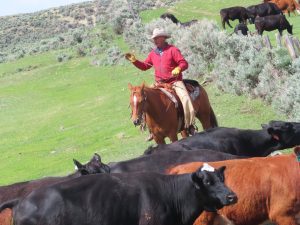 Zac Roberts: Shad Zachary (Zac) Roberts was born June 21st of 1957 to Dick and Leona Roberts of Merna, Wyoming. His siblings are Dru, Dianne, Louis, Jenny, and D’Lisa (known as Tub). His first horse was an imaginary horse that he would ride around the house. He preferred the imaginary horse over a stick horse because the stick horse wouldn’t lead when he got off to get the “gates.” He eventually started riding an actual horse and became part of the cattle drives by the age of six. In the first grade he started school in Pinedale and graduated in the class of 1975. He began starting colts at the age of seven. After his 14th birthday, Zac’s father passed away and his mom moved to town from the base of Merna Butte, and Zac moved out from living with his mom and started living with his older siblings trading work for rent. During calving season, he would ride pairs for Harold Thompson before heading off to school. His senior year of high school he was asked to rope at all but one of the brandings he attended.
After graduating from high school, he went to work for Stan Murdock in the fall, where he rode on the Green River Drift for Stan. He then worked for his brothers Dru and Louis until he would become broke and then he would hire onto the Miller Land & Livestock crew. He fed for Mike Noble a couple of winters with a team and sled and calved/worked for Millers while continuing to go back and work for Dru and Louis when he could afford to work there. He was riding his horse most of the time while working on the different ranches.
He married Patricia (Patti) Miller (granddaughter of Mildred Miller who owned Miller Land & Livestock). Right after they had married, they spent their summer living in a camper in the sections where they didn’t have running water and they moved cows every day. They then moved to the Beck place and doctored calves all winter and then calved at the Scott place before moving to the “V.”
When Miller Land & Livestock split up, Zac and Patti received the ranch known as the “V” in Daniel, Wyoming. This is where they raised their children, Ryan and Maggie, and where they continue to live. They received one stallion from Mildred and had several broodmares and raised horses until after the stallion had died of old age and they continue to ride a lot of Miller Land & Livestock horses. He would break the colts and start them for riding. Zac started implementing Black Angus on his Hereford cows and began raising Purebred Angus bulls. He would spend his evenings looking through bull semen catalogs and deciding what he was wanting to breed In June he would get up in the dark and AI cows using the headlights of the truck to check which cows were coming into heat and then ride the Green River Drift all day before resuming the breeding program again in the evening. In the fall Zac gathered his cows on the Green River Drift at the cutting grounds which was located near the Cora Y on highway 191. He was a pleasure to watch him work his horse whether it was a colt or broke horse in cutting the pairs or wild yearlings out. He was so calm the main herd was never disturbed.
Zac fed his cows with teams and a sled until the late 1990s or early 2000s after he started putting up round bales. He not only fed his cows with team and sled, but he fed the elk at the feed ground on the Rim. He also bought a couple of well-bred and trained Border Collie dogs and used them on them on cows and began to breed them for puppies. Zac’s cow dogs were also good help and not in the way when gathering the cattle off the Mesa and moving them to the mountains. The mother cows were not always chasing them off. In 2008, his herd tested positive for brucellosis and had to be depopulated. He bought cows, and although he did not return to raising purebred bulls, he rebuilt his cow herd and continues to improve them for the high elevation country.
Zac is now riding the range in the Hoback Basin where his family’s cattle graze during the summer and fall. He no longer goes to the hay field. He just cowboys. Today you will most likely find him on the back of a horse taking care of cows or in the shop building saddles during the cold winter months.