

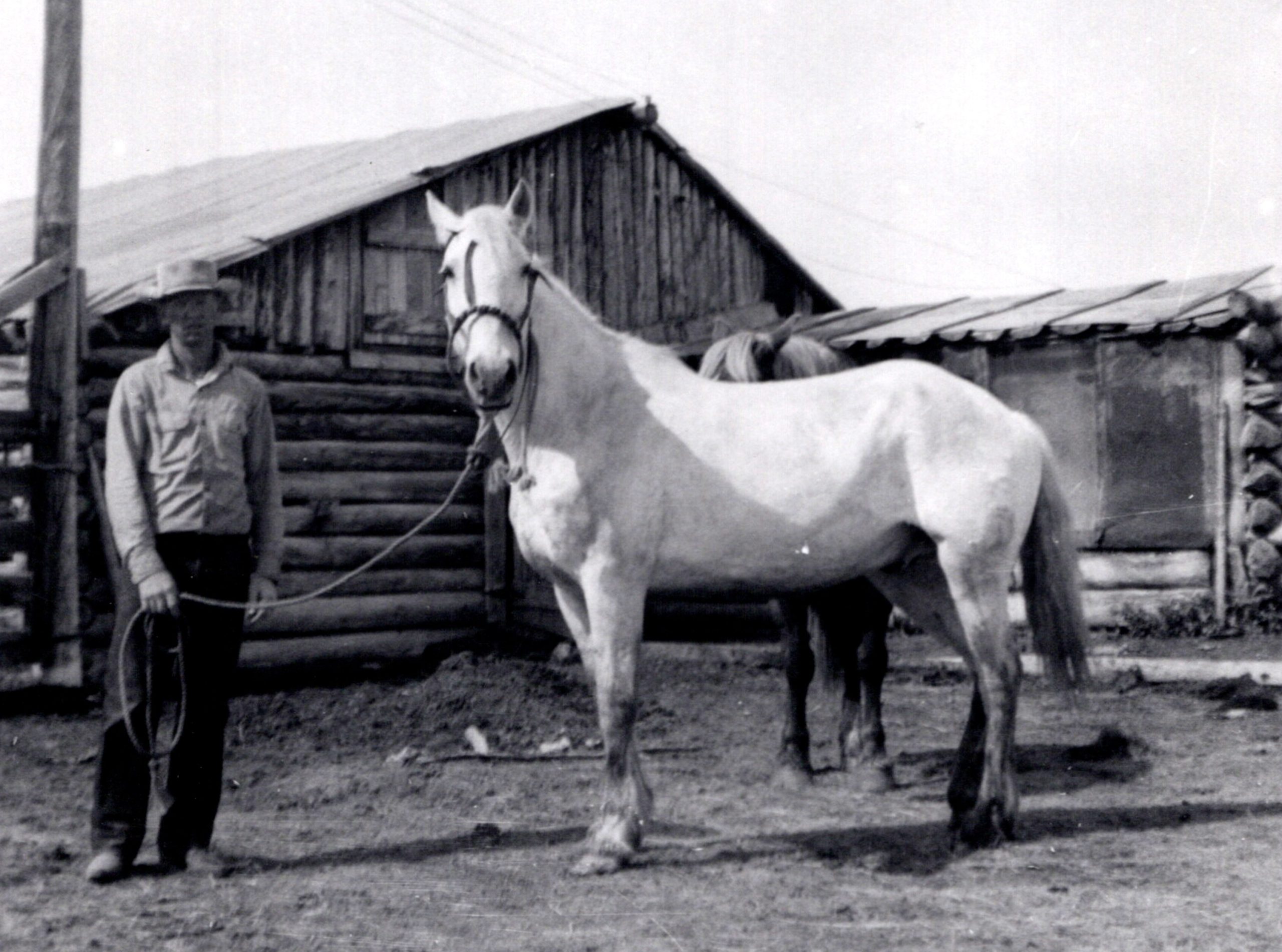
Maurice H. Henry was born February 11, 1918, to William (Will) and Bessie Mae Hayward (Mae) Henry at the family’s home on the old Brewster Place just east of Millburne, Wyoming. This rural community is in Bridger Valley, south of Fort Bridger in Uinta County.
Maurice was the fourth child of six, having three older sisters and two younger sisters. Maurice spent the whole of his long life living and working on the cattle ranch his parents established in the Robertson area of Bridger Valley, eleven miles south of Fort Bridger.
Maurice had just turned three years old when in April of 1921, the family moved to the Joe Miller homestead on Smithfork and Willow Creek in the Robertson area. Will and Mae Henry traded 520 acres in the Millburne area to Dan and Erma Watson for 316.5 acres in Robertson plus 100 head of good Durham Canadian-bred cows. This trade allowed both families to relocate to a more favorable area. The Watsons now owned land closer to their family who owned the property just north of their new holding.
It allowed Will and Mae Henry to get back to Robertson where Will had worked for Wallace and Joe Johnson shortly after Will’s family had moved to Bridger Valley in 1900 from Willard, Utah. Mae’s parents had a homestead in Pine Grove about four miles west of the Miller homestead, so she was living closer to them. While working on the Johnson ranch, Will had acquired 80 acres in Robertson from Tom Johnson. He later sold it in 1907 after they were married and took up a homestead east of Bridger Butte between Millburne and Fort Bridger. So now they were back in their much-loved Robertson area.
Once situated back in Robertson, Will and Mae worked hard to improve and increase their property. The cattle were summered on the open range on the northern foothills of the Uinta Mountains. The range stretched from the Smithfork drainage west to Blacksfork, and to the Piedmont area.
Will and Mae were always buying more land when a good deal came up. They were frugal and careful and survived the Depression years without losing anything. Will was a good stockman and hard worker and Mae had gone to business school in Ogden, Utah, plus worked as a bookkeeper before meeting and marrying Will. They made a good team and made decisions together.
They put together the base property of the present Henry Ranch. In the spring of 1929, they bought the Lincoln Gray homestead. This land adjoined the Miller place on the west. The family moved across Willow Creek and into the Linc Gray house, which was bigger and gave the family more room than the Joe Miller cabin. Maurice was 11 when this move was made.
Maurice recalled his first time gathering cattle as a young boy. He was with his dad and a neighboring rancher, Dave James. They were gathering cattle from the Horse Creek Ridge, Rasmussen Bench, and Cap White Mountain, all of which form high country between the Smithfork and Blacksfork drainages. That area runs from about 5 to 10 miles south of the home ranch. They left home early and rode to where they started the gather, and trailed the cattle back home.
Maurice was mounted on his horse, Old Snip. When they got to where the gather would start, Will explained to Maurice that his job was to follow the cattle down the country toward a pinnacle, known as Dan’s Nipple, on the west edge of Cap White. He told Maurice he would be gathering from one side and pushing cattle into Maurice’s bunch. Dave would be doing the same on the other side. He assured Maurice that even though they would be out of sight, they would be back and check on him. All went well, and Maurice had his first experience, at an early age, of working on the range.
During another gather off the same area, they picked up a cow with a young weak calf that was not able to keep up with the bunch. Will roped the calf and tied it across the front of Maurice’s saddle on Old Snip. He told Maurice, “You and Snip can pack this calf home.”
Maurice remembered it as a little roan calf with a white face. As they got close to home Maurice said to Will, “Dad, you ought to just give me this calf for packing it home!” All the other riders laughed and agreed, saying “The Boy” had earned it. And so, Maurice started in the cow business at a young age.
A few years later, Maurice noticed that his roan white-face cow was missing. He asked his dad where his cow was. Will told him, “Well, she was four years old and never had a calf, so I sold her. But you can have that young cow that’s branded on both sides to replace her. She has a calf.” So, Maurice learned that production was vital in the cow business.
As a pre-teen and teenager, Maurice helped on other gathers over in the Piedmont country west of Bridger Valley. The cattle all summered on the foothills of the Uinta Mountains and would get mixed as there were few or no fences. They would gather and sort an area and then move on to another. Maurice liked riding over at Piedmont with the Guild and Dean Ranch as they had a nice bunkhouse to stay in.
Often the older men would ask Will if “The Boy” could go with them on the day’s ride. Will always agreed. One time Delmar Dean asked to take Maurice with him. Will quietly told Maurice as he was saddling up, “Remember you are riding just as good a horse as he is. Keep up with him.” Maurice didn’t exactly understand what his dad meant, but by the end of the day he did. Delmar rode on a trot and a lope all day except when they had a bunch of cattle to start down country. Maurice kept up and learned, and made a life-long friend.
Other old timers Maurice rode with and learned from were Barney Smith and the Goodrick brothers, whose father came to Bridger Valley working for Judge Carter. He loved to listen to their stories about the old days and passed those stories on. He developed a love for western history from them.
Maurice spent his childhood, teen years, and early adulthood riding and helping his dad on the ranch. He learned roping skills, how to spot sick cattle, how to doctor them, castrate, brand, pull calves…all the necessary skills. He learned how to read cattle and understand them. He never hesitated to rope a calf, cow, or bull on the range if they needed attention.
Cattle to be sold were trailed to the UPRR stockyards and scales at Carter, which is north of Fort Bridger, loaded on the train, and usually shipped to Omaha, Nebraska, where they were sold. Maurice told about riding the caboose of the train, accompanying the cattle to Omaha. That era ended in the 1960s-1970s when buyers started contracting for cattle at the ranch and shipping was changing to trucks.
Maurice also learned horse handling skills from his dad. One of Will’s jobs as a teen in Utah was breaking horses for a horse dealer who resold horses to the army for cavalry mounts. They only had to show it could be mounted and ridden up and down an alley at a walk, trot, and lope for the horse to be acceptable.
Will did a lot of horse trading as well as raising both saddle and draft horses. Will and Maurice would get the young horses broke, and then anything was up for a trade. As a part of starting unhandled horses, Maurice learned to front foot them in order to get them down and restrained so they could be haltered, branded, or castrated.
As his dad got older, Maurice started and rode more and more of the colts. He said some he didn’t enjoy too much. He always said he couldn’t ride a hard bucker like his dad could, so he had to find ways to keep them from bucking. He learned to read each horse as an individual and handle them accordingly.
Later in life Maurice helped neighbors catch unhandled horses by front-footing them. Once the horse was down and someone on their head, someone keeping the front foot rope taut and straight out from the body, then a hind foot could be scotched up to a neck rope, and the horse was restrained. Then castration, branding, or haltering could be done without too much damage to horse or man. He also handled his own horses the same, with his wife and kids as the crew. (Later we discovered that gentling them as babies and yearlings made life even easier and less dangerous for horse and man.)
Will and Mae also had a small herd of sheep. Mae always noted the sheep gave them more than one paycheck. If one of the girls made a comment about the smell, their mother would reply, “It smells like money to me!” As a teen, Maurice would herd the sheep over in the Pine Grove place about four miles west of the home place. He had a sheep camp to stay in and often rode back home to help his dad and get supplies. The story he told of doing it in a lightning storm with sparks dancing along the horse’s mane and from the tips of its ears was pretty hair raising.
Maurice learned how to repair harness, put new strings in saddles, and other basic repairs. He made headstalls and hackamores, many of which are still in use. He attended grade school in Robertson and high school in Mountain View where he was a member of the FFA chapter.
In March of 1942, Maurice married Anna May Tripp, whose family came to Bridger Valley in 1910 from Kansas. They had a ranch east of Mountain View and another north of Granger on Ham’s Fork in Sweetwater County.
Maurice continued to work with his dad on the Henry Ranch until Will died in 1948. A decision was made by some family members to pasture the meadows instead of putting the cattle on the range, then sell the cattle in the fall. Uncertain of their future, Maurice and Anna May bought an acre from a neighbor to build a home on. One of his brothers-in-law, Sture Olsson, had a sawmill in Round’s Park. He got out house logs and he and Maurice built a nice small two-bedroom home on the land. Maurice, Anna May, and their three children, Karen, Garie, and Jean, moved there about 1949.
Maurice’s mother asked him to still take care of things on the ranch until she could find a way for Maurice and Anna May to buy the place. Maurice also worked for a neighbor, Bob Hickey, during this time. Things worked out using a state loan, and the family moved back on the ranch in 1953. Things were tough, but Maurice and Anna May worked hard and saved, using the knowledge gained from growing up during the Depression to get them through.
They had to rebuild the cowherd as they could from the cattle Maurice owned and had not been sold. Maurice once took some sale cattle to the Weber Livestock Auction in Ogden, Utah, in his little 1948 stock truck. He brought home about 10 head of yearling heifers that had come off the Arizona Strip area of southern Utah. They were Hereford marked with ring-eyes and some brockle faces. They were a little frosty at first but gentled down and made good mother cows.
As soon as the kids were old enough to ride, they became part of the ranch crew along with Maurice and Anna May. Maurice made sure the family was mounted on good, active, safe horses. He always rode a good horse, and if it was not a good one when he started, it was much improved in a few months.
He was always horseback when checking calving cows. He fed with a team, loading the hay rack by hand with a pitchfork, then heading out to feed, hitching the lines on the crosspiece, and pitching off the hay as the team ambled down through the field. He always had a saddle horse or colt he was breaking tied to the back of the hay rack. He would tie the team up and go through the brush on his saddle horse checking the cattle before and after he fed. He was out at daybreak checking the cattle, and again during feeding, mid-afternoon, and at dusk.
Maurice and Anna May continued to keep a small herd of sheep, but he ran them more like cattle… no herding. He kept them in pastures close to home and checked them during lambing. He got them in for shearing and docking. They provided fresh meat during haying. Finally, they sold them off when wool became more difficult to sell. They kept about seven wethers for meat, but they kept getting out into the meadow or the county road. Maurice was totally tired of fixing fence and made those “damn sheep” a promise. “If you get out again, you are all going in the frying pan!” Well, they got out again, so Maurice called his brother-in-law, Earl Landers, and offered him part of the meat if he would help him butcher all seven. And so, the final end of the sheep herd arrived!
Maurice, like his father before him, often shared work with neighbors and family. He always helped a close older neighbor, Bob Coburn, with branding. He and Bill Tripp, Anna May’s youngest brother, who had the Tripp ranch at Granger, always helped each other at branding and moving the cattle to forest and BLM permits.
For a few years in the early 1950s ,Maurice and Bern Whittaker put up hay together on their adjoining land. Due to a swamp fever or EIA outbreak in the 1940s many of the draft horses were lost and neighbors worked together in order to have enough teams to work the mowers, dump rakes, push rakes, and stackers.
When some good friends, Lemmie and Woodrow Swearingen, needed a place to keep their equipment and sheep while moving to a new property, Maurice provided a place for them.
Will Henry and Carl Wall had shared work on the Blacksfork cattle allotment, and when Maurice and Harold Harvey became the owners of those permits, they continued to work together to move cattle and shared the riding, salting, and gathering jobs. The allotment lies in Summit County, Utah, and runs from Painter’s Cache at the base of the Uinta Mountains north to the Utah/Wyoming state line. The east boundary runs along the steep Blacksfork Rim and up on Horse Creek Meadows. The west boundary runs along the west side of Blacksfork River. (Geographically, it’s more a part of Wyoming than Utah.) When the only road up Blacksfork from Pine Grove was a two-track wagon road, it would take three days to trail the cattle to the allotment, camping out two nights. On the third day, the cattle were scattered and the salt packed to the salt licks. Maurice and Harold were both very handy with packing and pack horses. Both family’s kids had great times putting the cattle on the forest. Of course, being cousins of similar ages, neighbors, and friends added to the fun.
After the Meeks Cabin Dam was built on Blacksfork and a gravel road was built to the state line, they continued to trail the cattle to the forest. Finally, as traffic increased and subdivisions were built in the area, the traffic and hassle became a problem. So now the cattle are hauled to the corrals at the state line, then moved to the appropriate pasture. The grazing period is from July 1 to September 30, when the cattle are gathered and trailed home to Pine Grove.
Maurice chose to stick with Hereford cattle when the majority of cattlemen switched to black cattle. He said, “Those old Hereford cows have been awful good to us and taken care of us through some bad times. I’m sticking with them.” It was a good decision and continues on with the present generation of Henrys. The home ranch is at over 7,000 feet elevation and the summer range runs from 9,000 to 11,000 feet elevation. The Hereford cattle don’t have the problems with high elevations as many of the black cattle do.
Maurice developed his Hereford cattle to be mostly free of udder and eye problems by culling anything that displayed a problem.
When searching for an easy calving bull to use on first calf heifers, Maurice first tried Jersey bulls. The calves were small and easy to birth, but not very marketable. Then Texas Longhorns were becoming known for light birth weights. Maurice had always been fascinated with the history of the Texas Longhorns and when a breeder in Fairplay, Colorado, had some yearling bulls available, he bought two to use on his Hereford heifers. He used Longhorn bulls on the heifers for the rest of his ranching career He kept some heifers for replacements and developed his own herd of almost pure bloods by breeding the crossbred heifers back to purebred bulls. He used some of the bulls he raised on the Hereford heifers. He never tried to sell the crossbreds with the straight Herefords. He always dehorned the calves to sell.
One year a friend, Jr. Martin, who had a roping arena asked Maurice if he would leave the horns on some of the Longhorn steer calves as he wanted to try them for roping steers for the team ropers who used his arena. They were having trouble getting Corriente steers from Mexico at that time. So, they made a deal. Later, after Jr. had been using the steers, Maurice asked him how they worked out. Jr. said the ropers didn’t like them. They were too fast! Maurice laughed and said, “I guess they were running AAA cattle on AA horses!”
Maurice passed on his knowledge of handling cattle and horses to his kids and grandkids. Garie and his family came back to the ranch after working construction for several years. Maurice enjoyed his grandkids, Bill, Jodi, Dana, and Matt. They all became part of the ranch crew at a young age. His youngest daughter, Jean, never really left the ranch. She taught elementary school in Green River and Mountain View and helped weekends and summers with haying, feeding, and moving cattle during her teaching years and after she retired. Oldest daughter, Karen, left the ranch after high school and later became a registered nurse and certified nursing midwife.
Maurice was back to starting colts in his 50s and 60s when Jean was raising Morgan Horses for the ranch. He passed on his skills to her and grandsons, Bill and Matt He rode his good Morgans until he stopped riding at age 90.
Maurice and Anna May were active in Farm Bureau for many years. They supported their children in their 4-H projects and their grandchildren in their 4-H and FFA projects. He made sure each child and the four grandchildren on the ranch had the beginning of a cowherd. He was an active member of the Robertson Livestock Association and also served on the Uinta County Predatory Animal Board for many years.
When they got into their 70s, Maurice and Anna May turned the ranch over to son, Garie, and grandsons, Bill and Matt. Maurice continued to ride and help with the ranch work. Despite some heart problems that required surgery, he kept riding and helping with the cattle. The last time he rode at age 90, he helped gather the cattle from the field and head them up the road to the BLM permit on the Horse Creek Ridge, Rasmussen Bench, Cap White Mountain area …. the same area he first rode with his dad and Dave James so many years before.
After his wife, Anna May, died in 2001, grandson, Bill his wife, Jenese, and family moved in with “Grandpa.” So, then he had great-grandkids, Amber, Cassie, Shantell, and Hugh, to ride with and pass on his knowledge and skills to. When he stopped riding, Jenese was working as a nurse, so Grandpa took over part of the cooking, making sure the kids had a meal waiting for them when they got home from school. He made the comment, “When an old cowboy can’t ride anymore, then he becomes the camp cook.” And that’s what he did.
Maurice died September 25, 2010.