

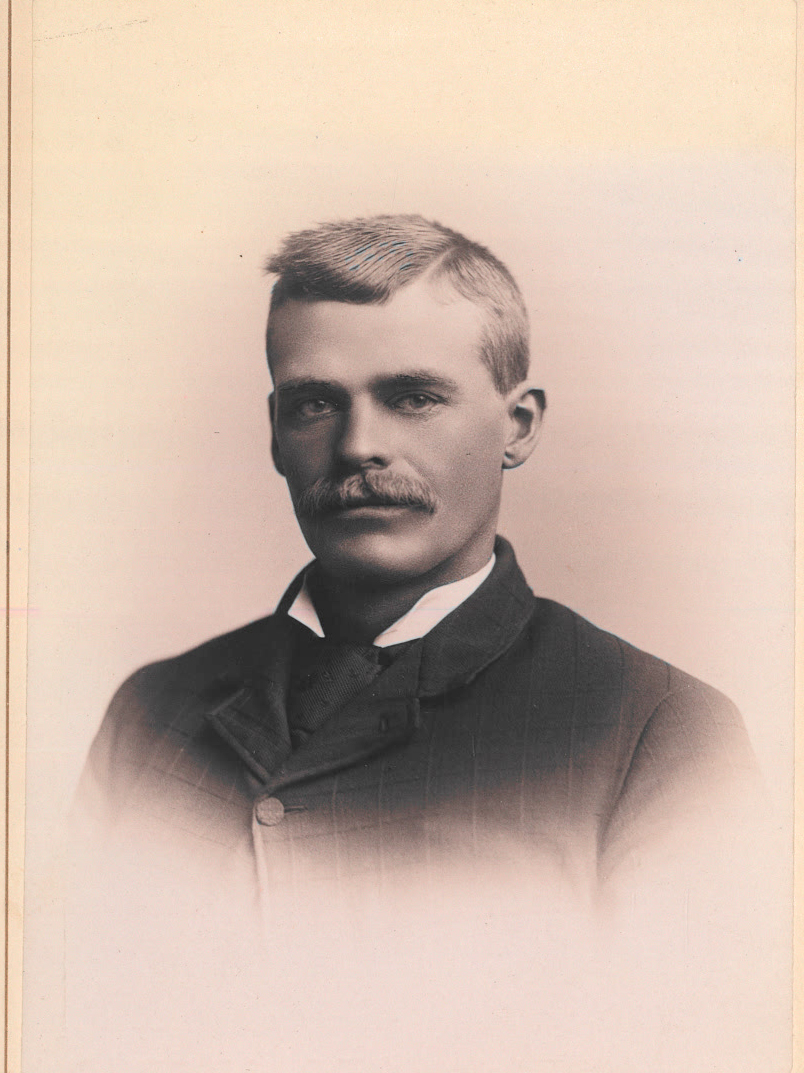
In 1882, at the age of sixteen, Al Osterhout left his home in Wanship, Utah, to work as a cowboy for Ed Swan in Big Piney. He later worked for Daniel Budd and Hugh McKay. Al rode the toughest broncs and grew a reputation of “having a way with people and animals.” For many years, he served as a foreman for the Big Piney Roundup Association and as a member the Big Piney School Board. Al’s jovial character endeared him to many, hence the nickname “Daddy Osterhout.”
After many years of riding for Swan, Budd and McKay, Al decided to give up the wage and took up a ranch for himself. Al “proved up” on 160 acres using the Homestead Act of 1862.
In 1894 Al married Sadie Budd. In 1903, Al and Sadie homesteaded the original acers of what is now the Guio Ranch. Sadie Osterhout acquired 320 acres of land through the Desert Land Act of 1877 for the price of $1.25 per acre. Land Acts required improvements on lands filed upon. Al and Sadie fenced the property and built a cabin, barn, and corrals. They grubbed sagebrush by hand and dug irrigation ditches using a team of horses and a fresno scraper. These ditches are still being used today.
The ranch now boasts the name Alsade Limited in memory of Al and Sadie and was incorporated in 1974. To date the cattle ranch is family owned and operated by descendants of Al and Sadie operating on 14,908 deeded acres.
Al and Sadie had two children. Their son, Chester, was born in 1895. He was tragically injured in a horse accident and died at the age of eight. In 1899 they had a daughter, Josephine, who married Harrison Guio in 1920.
Al was well known for being a master with a rope. Al would invite all the neighboring ranchers and hands to come to his corral where they would partake in a “Dehorning Bee.” The event would consist of gathering around 400 large calves in a corral, roping them, and cutting off their horns. About a dozen men could accomplish this task in about four hours. At dinner time the men gathered at the Osterhout table and enjoyed a dinner now only read about in novels. Al would then return the favor during dehorning season by showing up at each neighboring ranch to lend his help roping.
Several times each year Al and three or four hands would trail around 600-800 head of cattle from the homestead in Big Piney to Opal, to be shipped by train to market. They stayed at ranches along the way during this roughly 70-mile trail.
Al obtained and ran a prosperous ranch using hard working men and horse power. Every acre that was harvested for hay was done with horse drawn equipment. His original Double F brand is the oldest in the Green River Valley that has never been sold or traded outside of the family. Al’s ability as a stockman made the Double F cowherd prosperous. During his time, market cattle consisted of 3- to 4-year-old steers that brought 2 to 3 cents per pound.
Al passed away in May of 1941 at the Kemmerer hospital following a siege of pneumonia, but a heart ailment was the cause of his sudden passing. He was 75 years old.