

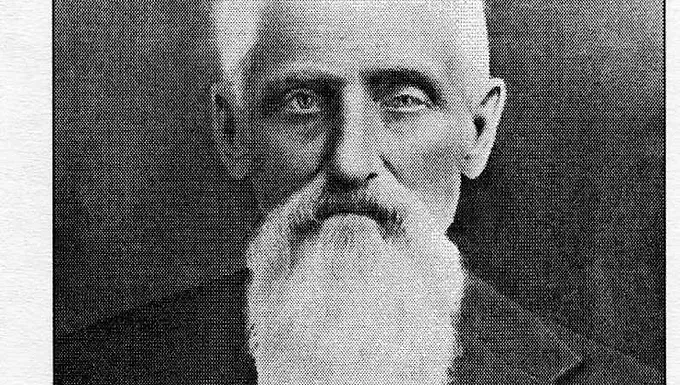
Elijah H. “Lige” Driskell (also spelled Driscoll, Driscol, Driskoll) was born November 3, 1838, in Kentucky. He left Missouri and went to California to hunt for gold. He came to Wyoming with Albert Sidney Johnston’s army at the close of the Mexican war, when Mexico ceded a large portion of the west to the U.S. As part of the so-called Utah or Mormon War, Johnstons army made a fast march ahead of their wagon trains. The army marched through to the crossing of Big Sandy, on the Old Emigrant Trail, near what is now Eden, where it went into camp, but the wagon train was captured and destroyed by a Mormon raiding party led by Lot Simpson.
To provide supplies for this army, herds of cattle were driven from Texas and it was with one of these herds that Mr. Driscoll, Phil Mass, W.A. Johnson, Sr., and others came to Wyoming from Texas. After the need of provisioning the army had passed, these men became associated with Bridger, Sublette, and other pioneers and a store and trading post was established in the Burnt Fork Section.
When the Civil War started, Elijah H. Driskell enlisted on November 9, 1861 as a farrier at Fort Jones, California in company M 2nd Regiment California Calvary. On September 11, 1861, he enlisted on the Union side at Fort Jones in 1863. He came to Fort Bridger as a member of Colonel Pat Connor’s California Volunteers. He was mustered out on October 4, 1864, at Camp Dodge, Utah. He then returned to Wyoming and again took up his residence in the Burnt Fork section, where he became a prominent rancher and stockman, and where he later conducted a mercantile establishment. Mr. Driscoll had led an eventful life, and its complete history would be more thrilling than any romance.
Lige, as he became known, went into the stock business. For a while, he ran a trading post on Ham’s Fork buying up gaunt, “foot-sore” stock from emigrants, fattening them up, and trading them back at a good profit. There is a record in the American Heritage Center of Elijah Driskell selling 2500 pounds of hay to the army for $25.00 through W.A. Carter in Ft. Bridger, Wyoming. On the 1870 census, he was living on Ham’s Fork with Julia Driskell and Cornelius A. Driscoll (Lige’s half-brother.) C.A. Driscoll and E.H. Driscoll were listed as members of the Bridger I.O.O. E. in 1885-86.
In the 1874-1884 Utah brand book, E. H. Driskell registered his “Wagon Wheel” brand that was on the left side of cattle on June 17, 1880 at Henry’s in Summit County. Stanley Graham, Pearl Finch Graham’s son, had the following to say in which Carol Lynn Gardiner had: “Old timers say he (Driskell) was the first rancher in that part of the Rocky Mountain states. Near as I can tell Driskell took Grandpa Finch in as a partner. They were the first people to upgrade their beef cattle with good Durham and Hereford breeding stock. They had the best horses in the country; they ran Morgan stallions with their range mares. They had the whole country to themselves and with the Union Pacific railroad only 50 miles away they could market their beef. They were a prosperous outfit.”
Lige had his cow herd so large by the mid-1880s he shipped cattle to eastern markets by train, and he could have been the first person to ship cattle by train from Carter, Wyoming. One story is Driskell, in his heyday, had so many cattle he shipped 2400 head of two and three-year-old steers at one time back East. It is said that by the mid 1880s Lige Driskell was running 3,000 head of Herefords and 1,000 horses. “His ranch was considered one of the biggest and best in the region.”
A water right for Driskell was not found in the Wyoming water book; only a ditch named Anson-Driskell with the first water right filed from that ditch in July 1888 by Charles Brendt for 140 acres. The first water right for the land Lige Driskell owned was filed during 1878 in Daggett County, Utah. There were 10 filings for water on the land Williams acquired in 1930 from Martha Finch. Elijah H. Driskell was issued a desert land entry on August 20, 1890 for 480 acres and a homestead entry on March 7, 1902 for 160 acres.
According to a thesis done by Donald Weir Baxter in 1959, “Lige Driskell settled east of where the town of Linwood, Utah was built. Lige, George Finch and George Hereford’s ranches were close together, and were west of the river going up the Fork. There was a school house between the Hereford and Finch ranches where Charley Driskell, Neil’s son, taught. In 1893, the surveyor, Adolph Jessen, came to finish surveying the land. With the help of Ellsworth Daggett, first surveyor-general of Utah, Mr. R. C. Chambers formed the Lucerne Land and Water Company. They built the People’s Canal. The town of Linwood was started in 1899 four miles east of Manila.” Elijah Driskell was a trustee of the Burntfork school district in the early 1900s. In 1910, Lige was living at Burnt Fork Wyoming.
It appears Lige was living in Pocatello, Idaho, with Henry and Alice McMillin as a boarder in 1920. (Henry McMillin was a teacher at the Linwood School in 1900.) Elijah “Lige” Driskell died on January 6, 1924 at Pocatello, Idaho, and is buried in Green River, Wyoming.
George Howard Finch II
George H. Finch II was born February 9, 1859, in Wyoming to George Finch and Janey or Judy (also have seen the names Cora, Julie and Julia) Finch. Judy Finch was a Shoshone Indian and married Elijah “Lige” Driskell in 1868. The following is a story in the book, Flaming Gorge Country, about George H. Finch’s parents: “A French-Canadian named Finch had been freighting for Carter and the story goes he’d been persuaded to go up the Green to a Shoshoni jamboree. He didn’t come back, so it was supposed some young [man] had admired his scalp and chosen that occasion to get it. Finch’s [woman], Janie, had a nice little string of horses, so Lige took up with her and adopted her son, baby George Finch. With his new family, Lige moved down and set to ranching near the mouth of Henry’s Fork. That was probably in 1868.”
“Another story about Finch’s disappearance was that he headed towards eastern Wyoming with a small herd of beef steers to sell to the railroad. He, along with his horse, crew and cattle vanished completely. Some blamed the Sioux who were fighting the U.S. Army at the time for his disappearance and Janey blamed the Mormons.”
George Howard Finch II married Martha Hereford February 13, 1881 in Green River, Wyoming. They were married at Henry’s Fork by R.E. Son, Justice of the Peace, and it was witnessed by E.H. Driskell and George Hereford. Martha Hereford was the daughter of Robert Lewis Herford and Lucinda “Hebe Jo” Menard Robertson Herford. They had 14 children in 20 years, who were Betty Stoll, Minnie Mass, Elijah “Buddy”, Clara Bell Hereford, Ella Ramsay Veach, George Joseph Howard, Alonzo “Lonnie”, Alice Jarvie, Winona “Nona” Nichols, Pearl Graham, Nora, Edgar and Stanley. George Finch died on January 10, 1919, in Linwood, Utah, at the age of 59, and was buried in Green River.
George Hereford, Martha’s brother, stayed on Henry’s Fork when his family left and Lige Driscoll took him in. George Hereford and George Finch became good friends. A cowboy by the name of Gavin Barr took the boys under his wing and taught them a great deal about horsemanship. George, as well as his friend George Hereford, grew up to be a fine-looking men and an expert horsemen. George Finch was liked and respected by almost everyone. It is said that George Finch and Shade Large would catch and deliver six to seven-year-old steers that had escaped from round ups and deliver them to new homesteaders in valley. George Finch became quite a famous cowboy during his time.
The following is a story about George Finch when he got married from the book Flaming Gorge Country: “Lige was mighty fond of his ward, George Finch, who grew up to be a fine-looking chap, an expert stockman, liked and respected by almost everyone. When George married Martha Hereford, Lige gave him a brand and told him to go into the cattle and horse herds and cut out whatever animals he thought should rightfully be his. George, for his part, was equally fond of old Lige, and only took what he thought was fair and square. Both men were proud of their fine horses. Their horse ranch was located up Dry Valley at what’s now called Birch Springs. It was sad day when the range got so crowded they had to get rid of most of them. That, combined with the trouble Lige had with his half-brother, Neil broke old Lige up. He retired to Green River where he died at the age of eighty-three. George took over the ranch and ran it until he died in 1919.”
Carol Lynn Gardiner had the following story about George Finch obtained from a letter Stanley Graham wrote dated 1995 to Harold and Norma Finch: “In about 1877 James Greenhow (Stan Graham’s stepdad) drove his team into Green River, Wyoming and noticed a small crowd beginning to gather—“what’s going on?” he asked. “Foot race.” somebody said. Greenhow noticed one of the runners was a tall, lean, wiry looking young fellow. When the race started that fellow left the others like they were running backwards. When he got near the finish line he ran backwards, laughing at the others, as he crossed the finish line.
George was issued two patents for land on April 15, 1896 under the Homestead Act. One was for 77.09 acres and the other was for 80 acres. The People’s Canal Company was formed to try and get water to the lower end of the valley. George Finch was part of this.
In the Official List of Brands in Wyoming 1899, George Finch had his brand recorded. It is a diamond with a squiggly line off of each point of the diamond and is called Diamond S (Boyd Pallsen owns the brand now in Utah and Gary Stoll from Douglas, who is George’s great grandson owns it in Wyoming.) On the 1900 census, George Finch was living at Current Creek, Wyoming. George was director and trustee of the Linwood School in 1907.
The November 5, 1909 Green River Star reported, “George Finch disposed of a large herd of cattle last week, James and Edward Barrett being the purchasers. Edward Barrett is now east with a large shipment of many cars.”
Lige Driskell and George Finch had built up the finest ranch in the country; they had a remuda of horses that was larger than most cattle ranches. By 1910, George Finch was living at Linwood, Utah, with his wife and five kids. The Green River Star on August 1, 1913 had Mr. and Mrs. George Finch going to see the Wild West show in Green River.
The following is a description of George Finch by Keith Smith in the book, Recollections of Keith Smith of Linwood, Utah, as told to his daughter, Susan in 1968: “While I was away from the ranch once again for a short time in the early summer an incident happened which showed the friendliness of my three-fourths blood Indian neighbor, George Finch. Several steers were stolen from my feed lot. George Finch found out about it and followed their tacks for two days. He told me afterwards that if he had caught up with the rustlers, he would have been forced to shoot them. Though he did not get close enough for this, he made the culprits feel so uncomfortable that they returned the cattle. George Finch had his own way of doing things. The beavers in Henry’s Fork frequently made dams which interfered with the water for his pastures. He set out traps for the beaver and, when he caught them, he told me he ‘willered them good,’ and then set them free.”
The following article is an article from the January 3, 1919 Green River Star:
Pioneer of Burnt Fork Passed Away Wednesday (January 1, 1919)
Word was brought into Green River yesterday that George Finch, one of the best-known residents of the Burnt Fork country, and a pioneer of that section, had passed away the day before as the result of a paralytic stroke. His two sons came into town for a casket yesterday and the remains will be brought to this city for interment, just when the funeral will be held had not been decided as we go to press. A son of the deceased was killed a few months ago on the battle fields of France, and ever since the news of his son’s death, the old gentleman has gradually been failing. He was over sixty years of age and was known throughout the county, and his passing will be mourned by many of the old timers, who knew him best. He was laid to rest in the Green River cemetery Monday afternoon. The funeral services were held from the Episcopal Church. Rev. Ward conducted the service, which was attended by friends of the deceased from all over the country. George Finch was born and raised in this country, and his sixty years of life, were very useful in assisting in building-up the county and state in which he resided. He was the father of twelve children, eleven of which with his good wife survive him and mourn his untimely passing. The Star joins in extending sympathy to the bereaved family.