

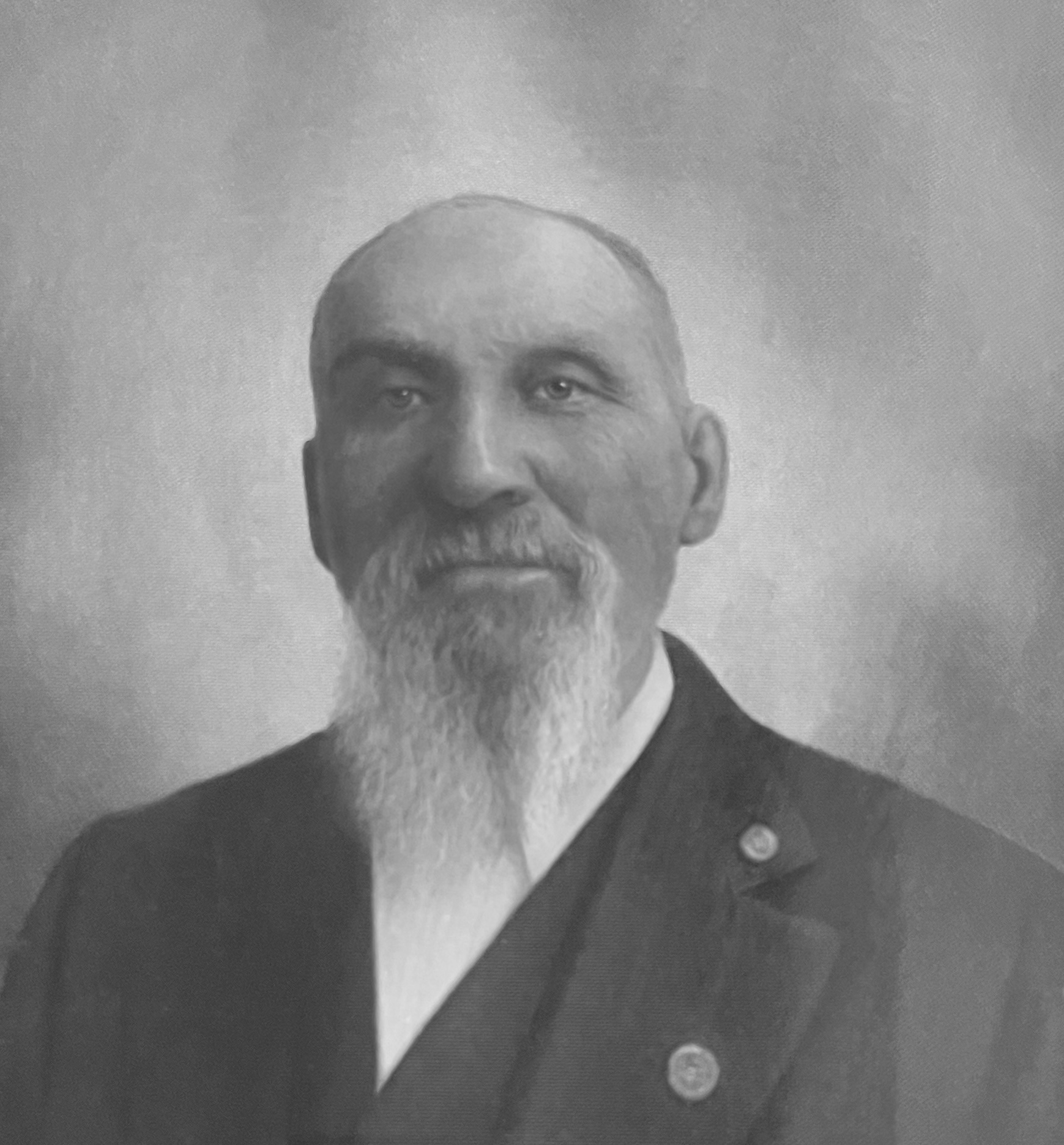
John Luman was born October 4, 1838, in Ohio, the oldest child or James and Martha Luman. He was living in Kansas at age 16 during 1854 and was employed at Fort Bridger, Wyoming in 1859. He worked two years for Judge W.A. Carter at Fort Bridger. In 1861, he was at North Platte, Nebraska ,and working for the Overland Stage as a hunter for Ben Holiday.
John was freighting in 1867 at Fort Fetterman, Wyoming. Luman hauled the first load of wood to the fort. He was back in Colorado in 1868 raising stock until 1872 when he went to Laramie, where he owned a livery stable and brought 200 cattle from Colorado. He was in Laramie until 1880. John Luman also married Susan Bissonette at Laramie in 1872. Their daughter, Flora Luman was born September 17, 1879, in Laramie County, Wyoming. They had two children who died in infancy. From Laramie, Luman moved to Lander.
Looking for a range large enough for his large bunch of cattle, he visited the Big Horn Basin. He found the country very inviting with plenty of good grass. In 1881, John brought a herd of cattle to Paint Rock Creek in Big Horn County. The company was then known as Tennen & Luman. Luman brought several thousand head of Texas cattle to Paint Rock Creek in 1882. By 1883, John had 6000 head of cattle according to Hunton’s diaries. According to the book, Paintrock Tales and Bonanza Trails, John Luman branded 3,000 calves in 1886 and after the bad winter of 1886-87 he branded 400 calves.
John Luman had 7,000 head of cattle in the Big Horn Basin in 1896-97 and the Bar X Bar Ranch at Ten Sleep, was seeking to please Eastern stockholders, offered Luman $200,000 for his brand. He held out for $250,000, but the company wouldn’t pay, and that winter it was said that Luman could have walked for miles on frozen cattle. He sold everything, including his saddle horses, for $12,000. In 1901-1902, John Luman was still a stockman at Hyattville. John Luman lived at Hyattville, Wyoming until his death on October 4, 1923.
John’s wife, Susan Bissonette Luman, was born on October 13, 1836, near Fort Laramie, Wyoming. They had three children, two dying in infancy and a daughter, Flora Luman Fultz Rannells. Mrs. Luman died on December 3, 1918, at her home in Hyattville.
The following information about John Luman was gathered from John Hunton’s diaries: “By 1872, John Luman was back in Wyoming with 200 head of cattle from southern Colorado, for range on Sybille Creek near Laramie, Wyoming. In 1876, he sold the Sybille operation to Swan and went to Montana. F.M. (Butcher) Phillips bought cattle from (Luhman) Luman in March 1877 for the Indian beef contractor. John Luman was back in Lander during 1880.”
The Bancroft interview with John Luman by George H. Morrison had the following information: “John Luman, who was living at Lander in 1881, brought a herd of cattle from Idaho with four herders and put them on Paint Rock Creek. His ranch was on Cottonwood Creek and on Nowater, with a horse range on Paint Rock Creek.” According to Hunton’s diaries in 1882, “Timmin and Luman brought several thousand head of Texas cattle into the Big Horn Basin to the ranch on the headwaters of Paint Rock Creek. They branded both cattle and horses with a ‘Moccasin,’” In the summer of 1883, John Luman had 6,000 head of cattle. In the spring of 1887, after the bad winter, Luman branded 400 calves even though in the spring of 1886 he had branded 3,000 calves.”
According to the article, “When Cattle Came to—and then Left—the Nowood Valley” by Lawrence M. Woods in the Winter 2017 Annals of Wyoming: “Frank S. Ainsworth, another early trapper, ” In 1882, John Luman brought herds to the Big Horn Basin, where he settled later on the lower Nowood, becoming the first “resident” ranch owner there—distinguishing him from the nonresident owners of the other large herds, who lived outside the basin and in England… At some point, Luman met and married Susan Bissonette, the widowed daughter of the French trader and interpreter, Joseph Bissonette, and an Oglala Sioux woman. The Lumans moved to Lander in 1875 and were living there in 1881, when Luman was about to start across the mountains to the basin with two trail herds of Idaho cattle to launch his cattle ranch. Byron Wickwire (later sheriff of Big Horn county) met Luman there, and since Luman was short of help, he was glad to hire Wickwire, who was then seventeen.
“The morning after they met, Wickwire went out with Luman to start the herd north, and Luman went along with him until the herd reached the Wind River, and then apparently satisfied of Wickwire’s abilities with cattle, turned back to bring another herd on the same route. In fact, Wickwire did not see Luman again until a month after the first herd had crossed the mountains and come down to the Big Horn River. The route to the basin was along the right (south) bank of the Big Wind River, crossing Bad Water Creek, and then northwest over the Owl Creek Mountains to Kirby Creek. At the mouth of Kirby Creek, in September 1881, the herd crossed to the west side of the Big Horn River and was turned loose to graze there, just north of the Wind River Reservation.
“Luman second herd of about 4,500 head pastured both sides of the Big Horn. Luman then had a total of seven thousand head of cattle in the basin, carrying the Moccasin brand, and Wickwire and one other man had the task of wintering 135 head of saddle horses at the mouth of Nowater Creek. Luman’s men built a cabin and corral for the two men they were leaving behind, and then left for Lander. The winter snow did not bury the grass, and the cattle came through the winter in fine condition. The men ate well—or at least they had all the meat they wanted, including buffalo, elk, antelope, deer, and bear meat. Wickwire said that there were about forty head of buffalo on Nowater Creek during the 1881-82 winter.
“During that winter the only visitors to the Big Horn River were Crow Indians from the reservation in Montana, who were going back and forth to Fort Washakie. The Indians had not abandoned the hunting trips in the Big Horn Mountains, and they soon learned that John Luman was married to Susan Bissonette, who was descended from the Sioux tribe. After Luman moved to the Paintrock with his wife, the Crows often camped near the Luman cabin, so that they could visit with Mrs. Luman.