

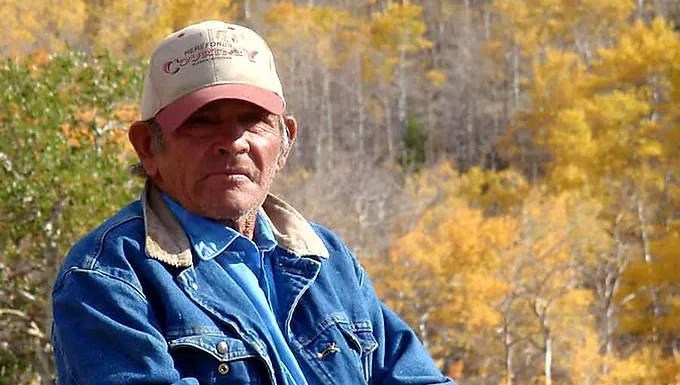
On April 18, 1931, the second child Jeptha Everett Richie was born to Everett “Ebb” and Ellen Williams Richie joined a sister, Verla, who was seven years older. A brother, Norman Henry Richie, arrived on March 23, 1933. The first part of Jep Richie’s life was living on his father’s 1914 homestead on Muddy Creek. Jep attended the Big Sandy School for a couple of years before it was closed, so Richies moved to the Allen place on Eastfork that they had bought in 1936 and became known as the home place where the boys attended the Olson School. Jep also attended school at Boulder for the seventh and eighth grade. He attended high school in Pinedale where he graduated.
All the Richie kids were expected to work on the ranch at an early age. When Verla was 14 and Jep was seven, their dad sent them to the Juel Place on Lander Creek about 20 miles from the ranch a horseback to pick up some of their horses that had been running on the desert and gotten away from Richies. Paul Juel had corralled them with some of their horses they had gathered off the desert. When they started the horses for the Richie ranch, two of them would not stay together because they had been running in different bunches on the desert, so they ran them back into the corral where Paul Juel front-footed them and put halters on them yoking them together so Jep and Verla could drive the horses home. Nothing was thought about a seven-year-old boy riding a 40-mile trip in one day.
Jep came by his love of horses naturally. His father, Ebb, loved his horses, so he had lots of them. At one time, Ebb had about 200 horses on the desert. In the spring, about the first of June, he would gather the mares he wanted to breed. He would put them in with the two studs. He had a saddle stud and a work horse stud.
Jep and Norm’s interest in rough stock started at an early age riding calves and their bronc riding started as soon as they sat on a Richie horse. Jep and his brother both loved to ride rank horses, the ranker horses meant for better stories. They entered their first rodeos at the ages of 21 and 19. Jep and Norm traveled the country rodeoing for many years. Their dad died in 1955 and the Richie boys slowed down their rodeo career to run the family ranch. Their love for rodeo continued and they became very active in the Sublette County Sporting Association. Rodeo was a weekly outing. Jep and Norm were judges. The Richies furnished a majority of the bucking horses for the rodeos and cared for all the associations’ horses for 20 years.
At a rodeo in June 1955, Jep happened to meet Barbara Vaughn, past Lander Rodeo Queen. They were married on September 11 of 1955. Jep and Barbara had three kids who were Carole, Lynne, and Eb. They have eight grandkids. Barbara died in 1989.
In 1959, the Richies again added to their ranch by purchasing the Vible place on the New Fork River.
Anyone who knows the Richies can tell you that a fine Hereford cowherd defines much of their identity. Jep and Norm are not shy about telling you they like the disposition of the Herefords better than the black cows. When asking Jep’s son, Eb, why the Herefords, he said, “Dad told me that the English breeds, mainly Hereford and Angus, have been here for 100 years, and will be here for the next 100 years. Lots of the other breeds have come and gone like fads.” Jep’s daughter Carol said, “I think our cow herd is generational. The Herefords were here when Jep and Norm took over the place, and are still here today. Norm recalls that when they took the place over from their dad, he and Jep worked hard to clean up the scallywags and improve their genetics. The hard work paid off, proven by the fact that if you drive through their herd as they trail them down the road, you’ll say to yourself, “Man I wish my first calf heifers looked as good as theirs!”
Jep’s legacy has not only been defined in their cows. Stories of large desert horse herds, cutter races, and bronc rides are just a few more. Maybe most important is how good of neighbors they have been, and how much the neighbors look to them for leadership and honesty. Jep will help the neighbors any way he can. He ran the fork at the dipping vat for years and was the brander at the brandings.
Jep is still living on the ranch at age 88. He has not ridden for several years, but knows what is happening with the horses and cattle.
Carole Richie remembering back on her life as Jep Richie’s daughter: “Dad’s life centered around horses. He started out cowboying hanging onto his dad on the back of a horse, at the homestead on the Muddy ranch. Everything had to be done horseback or with horses. Teams, cleared the ground, dug ditches, did the haying, fed the cows. Ranching was not done back then without horses. The cows and horses were moved horseback. When I ask Dad about the past, he just says that’s the way it was. He will very rarely talk about himself. So, prying early childhood stories out of him is impossible. The neighbors all say those Richie Brothers were two hard working, tuff SOB’s.
“As a child, most my memories of my Dad involve horses. The seasons turned around working horses. Every winter dad had a corral of weaner saddle colts and work colts. After he spent all morning feeding cows with a team of horses, he started young teams on a skid, & broke colts to lead. This was done every day. In the spring he’d start breaking young saddle colts. Dad is really quiet and gentle with his horses. He never raised his hand or voice. You could see total respect in the eyes of the horse and dad. All his horses were well mannered and handled well with a gentle touch. The horse he talked about as his life time favorite was ‘Mickey’ a catch colt that he said could cut out from under you.”
Richie horses had a reputation of being “rank,” so, there were lots of wrecks. Carole said, “I remember dad coming in the house once with his head covered in blood. He had been struck, by one of his green horses.”
Spring is when it gets busy, on the back of a horse, lots of cutting, sorting, branding and turning cows out. Then it’s time for summer roundup, gathering off the BLM and on up to the Wind River Range for summer grazing. ranchers did put a month haying sitting on a tractor instead of a saddle. Fall, back in the saddle gathering again, a continual cycle of cowboy work. When it came to turning out and gathering the cattle it involved many miles on a back of a horse. We have three different allotments.
Carole added: “When Dad was not working horses on the ranch his life still evolved around horses. He was a bareback rider in his younger days. I heard he could have gone pro, but his dad died and he choose to run the ranch. He participated in the Green River Rendezvous as a pony dancer. And was very much involved in the Sublette County Sporting Association. He judged their rodeo, served as an officer, and furnished most of the bucking stock. One story Dad did tell was about supplying rodeo stock. Rodeo Stock Contractor, Harry Vold’s stock truck broke down and the bucking horses could not get to the Big Piney pro rodeo. They called the Richies to see if they had stock they could bring in for the bucking horses. They brought 32 head in to the rodeo and only 3 were covered. Vold wanted to buy the horses. Dad said, ‘Those are our saddle horses.’ They pulled a few off to ride and sold the rest. He was pretty proud the pros couldn’t ride his saddle horses.
“Dad was still breaking saddle horses at the age of 73. Oprah bucked Dad off pretty hard. Of course, you get back on. She bucked him off again. Needless to say, he was lifeflighted to Salt Lake City. It was several months of recovery. Dad continued on riding until he was 83.