

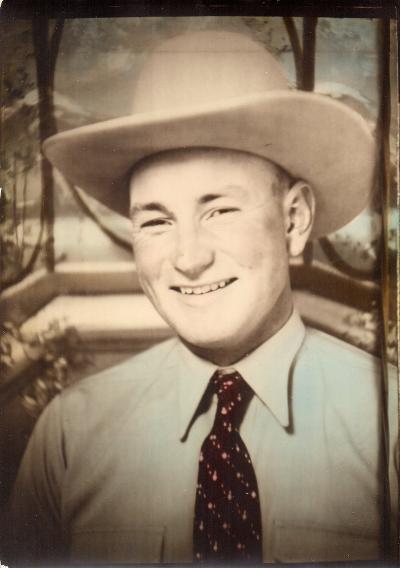
 Gladwon David Thomas Jensen was born June 23, 1909, to Martin “Metinus” Jensen and Hannah P. Dodd Jensen on the Jensen Ranch on Muddy Creek near Olson, Wyoming. His siblings were Clarence (Huckelberry) Jensen, Fred “Ted” (Huckelberry) Jensen, James J. Jensen, Rennard Jensen, Glen Jensen, Floyd Jensen, Otto Jensen, Lawrence Jensen, Lily Spann, and Edna Georgis. Gladwon went to the Emerson School from 1914 through the spring of 1925.
While working on his parent’s ranch he learned a great deal about horses from his father. A biography of Hannah and Martin Jensen written by Ann Anspach, January 20, 1988, had the following: “Martin loved horses and raised them to use and sell. Martin was good with stock and raised horses, cows, sheep and pigs successfully. Martin or the older boys would drive horses and a sled to school with the children sometimes in winter. In earlier times, they rode horseback to the post office when they wanted their mail or an excuse to see the postmaster and hear the latest news. Running herds of wild horses and running in the ranch teams to start haying was also great entertainment for the young men. Many of the horses used on the ranches had been captured from wild herds. Also, many mares in the wild herds had been branded, but joined the wild herds and produced ‘wild horses.’
“People had to try to make a buck when they could. Everything was done with horses on the ranch like haying, fencing, hauling lumber, feeding the cattle, plowing, planting, etc. Jim Jensen was usually the foreman on cattle drives from the East Fork/Muddy/Big Sandy area. Cattle destined for market, belonging to several outfits, would be thrown into a herd of 600 or so head. It took 9-10 days to make the round trip. They would generally night herd six nights. There would be five or six cowboys and one cook with the sheep (chuck) wagon. One time, they got the herd right to the stockyards and the switch crew blew a whistle. The cattle stampeded into a gully and some were trampled to death. The railroad made good on the loss. They took the cattle to Winton near Rock Springs. The cattle were loaded on the train and a caboose was furnished for the stockmen to ride to Omaha where the stock would be sold at the auction. Gladwon went on the beef drives to Winton or Rock Springs so the cattle could be shipped on the railroad to Omaha where they were sold.”
Gladwon worked on his parent’s ranch until he was 16 years old when he went to work for his brother Glen at the John Vible ranch. Glen got Gladwon to go to Green River City to see about jobs on the Union Pacific Railroad but Gladwon was soon back on Muddy Creek breaking horses for Frank Robinette and later returning to work on the Vible ranch.
He next went to work for Knute Jomen on Knute’s ranch on Pocket Creek, where he continued to ranch after Knute’s death, later marrying Knute’s widow, Edith Jomen, on September 21, 1931, in Rock Springs. He continued working on the ranch and cowboying while helping raise Edith’s two children, Margaret and Tom Jomen. Gladwon was still doing all the ranch work with horses like feeding, haying, taking the cows out on the desert for spring pasture, gathering them and driving them to the summer range up Jim Creek trail to the Silver Creek Grazing Allotment and then gathering them in the fall with the neighbors which involved sorting each ranches cattle into a separate herd or cut to take home for the winter.
About 1933, Otto contracted with Martin, Williams, Zembos, Hittles, and Gladwon to take horses to the Winton corrals to sell. He would be paid $1.00 per head by the ranchers. More than 100 head of horses were bunched and Otto with his crew, Gladwon and Henry Hittle, set off. Otto had to pay for water at The Wells and 14-Mile at $.10 per head. He paid Gladwon and Henry wages, and he paid E. J. Howell for pasture on Sandy. North of Farson they left the horses in a corral. The cowboys stayed at Earl Pulley’s house. Someone stole a horse that night. When all was said and done, Otto came out behind, except for the experience. Some of the ranchers made out fine as many of the horses were fresh branded wild horses.
Otto recounted a beef drive experience. Gladwon, Brandt, Jim and Otto Jensen, Art Lance, Ray Boulter, and Eb Richie went on the cattle drive to Winton. They had the horses tied up and some of the men were in their tents, some were night herding, and the ones coming off night herding at 3 a.m. were graining the horses. An old Zembo horse sucked oats up its nose. When flying back in fright, it stuck a foot between Eb and Art Lance’s heads in their tent. They came running out of the tent in their underwear shaking and laughing. The cattle were loaded on the train at the Winton stockyards where a caboose was furnished to the stockmen to ride to Omaha where the stock would be sold at auction. Martin always went on this trip as did many of the other ranchers. The biggest part of their income depended upon a successful trip to Omaha. Otto accompanied Gladwon on this trip in about 1933. The hitch broke on the car the Zembo cattle were in. Another train had to pick up that car. Gladwon and Otto requested a coach car so they wouldn’t have to try to sleep on the wooden bench in the caboose. In the coach car you pulled out the chairs to make a bed. The Jensen boys were having trouble getting the job done, so put a little muscle in it and pulled things clear apart, knocking out the car window in the process.
Joel Bousman remembered the following about Gladwon: “Gladwon had a reputation among his neighbors in Boulder as being a real cowman. His reputation Hereford cattle were considered among the best quality in the Boulder area.” His grandson Joel remembers helping gather cattle from the BLM to move onto the Silver Creek Forest grazing allotment. “I learned a lot about gathering, working and sorting cattle to go up the mountain. I remember learning from Gladwon about the need to have patience when mothering up cows with their calves to remove from the herd. I remember Gladwon going to the Budd Ranch Bull Sale to purchase good quality Hereford bulls in order to maintain his reputation cow herd. I also remember that it was Gladwon who took me deer hunting when I harvested my first deer.’”
In the years 1947-1948, Gladwon was the cowboy on the mountain for the New Fork East Fork Cattle Association. Gladwon had been taking Jensen and Jomen cattle to the mountain range and gathering them since he started riding horses. He knew how to take care of the cows on the mountain allotment.
In 1965, Gladwon and Edith were divorced, and Gladwon later married Ruth Perret Wenz in Pinedale. Gladwon was riding for the Fish Creek allotment the first year Katherine Campbell rode for Jack Creek Association. Pfisterers had cattle on both allotments so they rode together sometimes mostly in fall. Kevin Campbell remembered when Gladwon was riding in the Hoback Basin, he roped at Jake Pfisterers’ branding. Jake liked how Gladwon handled cattle and trusted him with his cattle.
Gladwon cowboyed on the Green River Drift for four years, which included 1975 through 1978. He was a good cowboy and kept the cattle scattered on the range. His wife would help him at times. He always requested Bud Sommers send him the same two horses every year for him to ride on the mountain because he liked how they handled. Bud Sommers was foreman at the time and he told his son, Albert, that he never had to worry about the cows being taken care of correctly. He just knew it was being done. Gladwon Jensen died January 3, 1996, at the Pinedale Retirement Center.
 Otto F. Jensen: Otto Jensen would tell you that he was born on the ranch and worked there “since he was big enough to drag a diaper.” The ranch he was referring to was settled on by his dad, Martin Jensen. Various homesteads of others, including Otto, were gradually added to Martin’s original holding. Otto’s first job was to help his siblings gather sagebrush for the stoves. His next job was to help keep the sheep off the meadow. When they were lucky, they had a horse to help with this task. Otto and his younger brother, Lawrence, had a dog, Old Jack, to help, but Jack died, and finally the sheep grew wise,when the boys continued to call, “here Jack.” This illustrates the ingenuity and sense of humor Otto maintained throughout his life.
Otto lived on the ranch his entire 81 years except for a short time working on the Jorgensen ranch helping drive their herd of cattle from Pinedale to Jackson, in the winter, as hay was short in Sublette County, and another short stint as the packer for the Civilian Conservation Corp (CCC), taking his pack string from Big Sandy Lodge to the Boulter Lake Dam project, designed to help extend the irrigation season by a few days for the area ranches.
As a young man Otto spent a great deal of time in the saddle, running in wild horses and gathering the ranch horses off the range for haying and again in the fall for feeding. The horses had a huge area of open range, and the boys would sometimes stage a change of horses to have the upper hand. Throughout his life Otto broke many of the ranch horses to ride or drive. He drove cattle with his neighbors from the spring desert range of the Square Top Association to the summer mountain allotment, taking them up the Jim Creek Trail. In early years, before the Square Top Association was formed, the ranch cattle were run on the Big Sandy end of the range.
Neighboring ranches ran their stock together, thus requiring ranchers to separate their stock, sometimes between the spring and summer allotments and completely in the fall when the cows drifted home from the mountains. Otto always had two good horses and he alternated days using them. He usually chose mares as he wanted to be able to get colts from these good horses. He would hold his horses to a trot when they wanted to “head for home,” and they always developed into very fast trotters. He felt he could cover a lot more miles, with less stress on horse and human, on an extended trot.
In the early days, Otto went on the fall cattle drives to the railroad at the Winton stockyards, over 80 miles away. He would tell stories of the stampedes at night and always talked about their camp at Ten Trees on the Big Sandy. He also got to accompany the cattle on the train to Omaha, and that was the farthest he ever ventured from the ranch.
Otto always had a cowboy hat and a pair of good leather gloves so he could be ready for any work required. At the brandings, where neighbors help neighbors, he was the castrator and occasionally ran the irons. It was a treat to see him rope a horse out of a herd in the corral, using long practiced technique. Otto was frequently alone doing the cattle work, as the kids were in school, so he developed many skills to get the jobs done. Otto was tough. He was a big, physical guy, not afraid to face rough weather or rowdy stock.
Otto was an organizer of many projects to serve the area ranches and was president of the Square Top Grazing Association and the Green River Vally Cattlemen’s Association. He also served on the school board. Otto completed his formal education at eighth grade, and then worked full time, generally daylight ‘til dark, except on most Sundays. Feeding, milking, doctoring, calving, and haying often got in the way of Sundays off, too. The ranch always came first.
About 1933, Otto contracted with his dad, Martin Jensen, Williams’, Zembos, Hittles and his brother, Gladwon, to take horses to the Winton corrals to be sold. Otto was to be paid $1.00 per head by the ranchers. Over 100 head on horses were bunched, and Otto with his crew of Gladwon and Henry Hittle, set off. Otto had to pay for water at “The Wells” and “14 Mile,” at 10 cents per head. He paid Gladwon and Henry wages, and he paid E. J. Howell for pasture on Sandy. Near Farson they left the horses in a corral and stayed at Earl Pulley’s house. Someone stole a horse that night. When all was said and done, Otto came out behind, except for in experience, which shaped his conservative nature. Some of the ranchers made out fine as many of the horses were freshly branded wild horses.
Otto was a storyteller. He entertained the young people who worked on the ranch with his tales of cattle drives, chasing wild horses, and the pranks of his brothers and others. He did not lack the ability to laugh at himself, too.
Otto was a teacher. He taught innumerable young city kids how to safely operate haying equipment. He taught his children cowboying skills and how to stay safe on the ground and in the saddle. He taught compassion for animals and how to recognize subtle signs of illness or distress in livestock.
In 1971, Otto suffered a stroke and 10 years later an aortic aneurysm, and after a minor accident on a horse, he realized that his balance had been affected to the point that it was no longer safe to ride, so at age 72, he retired his spurs. Otto died at Sweetwater County Memorial Hospital in Rock Springs.