

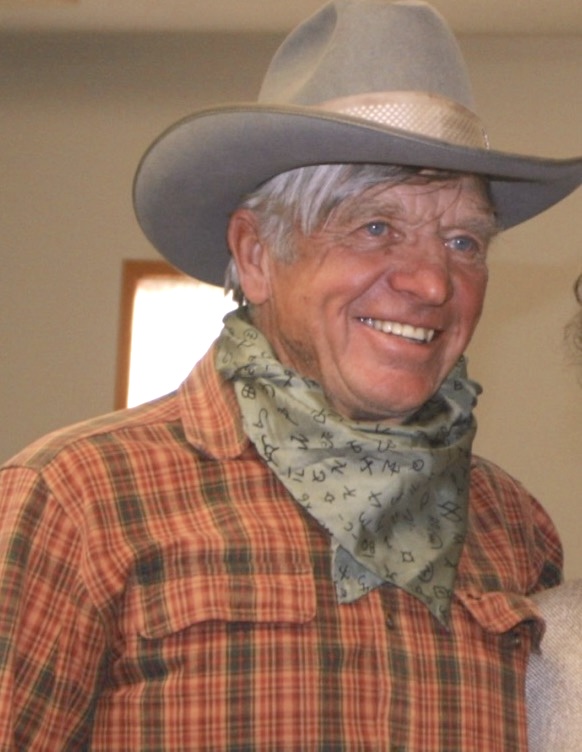
Jack C. Malmberg was born in Valentine, Nebraska, in 1940. By the time he was five, his father Emil—manager of the Three Bar Ranch—expected him to work as capably as any hired hand on the 5,000-head cattle operation. With so many eligible men serving in World War II, extra help was scarce, and Emil often reminded his young son that ranch life required working the four “S’s”: sunup, sundown, Sundays, and then some. Still, he didn’t consider his true wage-earning cowboy career to have begun until he was twelve.
From those early years, Jack saddled up and held herd, helped calve, roped, branded, castrated, vaccinated, and trailed cattle to the railroad. He learned the skills of a teamster, driving horses to feed hay, fix fence, and repair windmills. He even worked in the blacksmith shop. One of his most cherished mentors was an old timer who had ridden herd in the 1890s. That seasoned cowboy taught him the art of using a horse wisely—how a good cowboy could work one all day without wearing him out, and how “it takes a good cowboy to ride a bucking horse, but a better one to keep a horse from bucking.”
As he grew, so did his wages—beginning with the gift of a yearling calf each fall and rising to $150 per month by the time he finished high school in 1958. When the Three Bar Ranch sold in the spring of 1959, he hired on at the T-O Stutter place and the Ravenscroft Cross-O in the Nebraska Sandhills. There he broke and trained saddle horses and workhorses while performing the full range of cowboy duties. One rancher regularly brought him three unbroken three-year-old Poco-Wino quarter horses; after a year of training, the rancher would choose one, he would choose the next, and the rancher kept the third—before bringing three more.
In 1962 he was drafted and spent two years as a paratrooper, all the while yearning to return to cowboy life. When he did, he spent five years on the Hill Ranch, the V-Bar-Bar, where all the work was done on horseback and loose hay was fed using six-horse teams. During those years he broke and trained most of the ranch horses, and each cowboy was expected to ride alone, rope, and doctor cattle without assistance.
Afterward he spent six years managing a range outfit before moving to Wyoming in 1974. His first winter there he rode for Fred Anschutz at Elk Mountain on 100,000 acres along the Medicine Bow River. From there he went to Newcastle, where the Malmberg Cattle Company consisted of him, his older brother Don, and nephew Tony. Before long they moved to Twin Creek in Fremont County in 1978, where they grazed cattle in the vast Great Divide Basin—80 miles north to south and 100 miles east to west. Alongside several neighboring outfits, they ran 500 head on the open range.
He considered himself lucky to experience the final three years before the basin was cross-fenced. Under the direction of wagon boss Bill Hancock, a crew of 12–15 cowboys conducted a three-week fall roundup, gathering cattle by sections and sorting them to their home ranches. No four-wheelers and no dogs—just horses and cowboys.
The financial crash of 1981 hit hard, forcing bankruptcy, a fate shared by many ranchers. The bank didn’t want his horses, harness, or horse-drawn equipment—things he couldn’t bear to part with—so he turned to the woods, eking out a living as a horse logger while his wife and three school-aged children remained in the valley.
As many ranches transitioned to motorized “ponies,” he kept to the old ways, continuing to train and work horses. Each morning, he saddled up to wrangle the workhorses, who had free range to graze on Green Mountain, Togwotee Pass, or wherever logging contracts took him. In the off-season he day-worked for ranchers such as Albert Hornecker, Rob Hellyer, Roger Buckmeier, Guy Givens, and others.
He logged with horses for about twenty years, up to the year 2000. Then he shifted to a serious hay-contracting business, using his Belgians to mow and rake the fields. The horses—many of them trained by him—were well conditioned and eager for work. Each year they put up 300–500 tons of small square bales.
He still breeds and trains horses, currently working with four young ones who will join nine seasoned Belgians—and one Morgan gelding—for the summer’s work. He and his wife craft their own harness, skills they learned under master harness-maker Jim Ware in Laramie. He builds wagon tongues, doubletrees, singletrees, jockey sticks, and more. He even has a distinctive hobby: weaving used baling twine into halters, bridles, ropes, and any other tool he imagines.
Now, at age eighty-four, he recently completed building a hay barn—one he hopes will finally keep the elk out.