

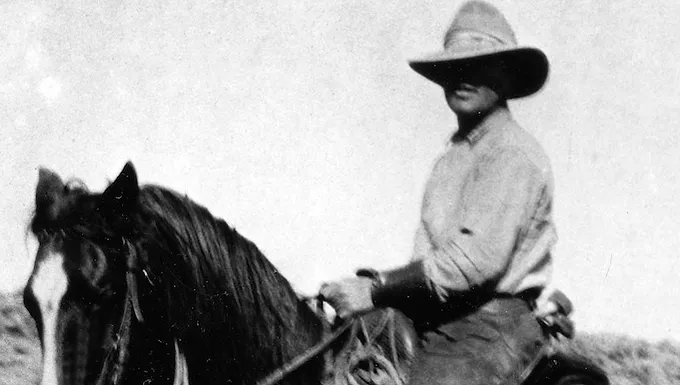
Henry Huff Williams was born on August 4, 1897 in Atlantic City, to Henry Watkins Williams (1860-1936) and Maud C. Huff Williams (1875-1956.) He had nine siblings of which eight lived to old age. They were Alma Golliher (1900-1991), Baby Boy Williams (1902-1902), Ellen Richie (1903-1997), Dorothy Thompson (1905-1979), Jared Williams (1907-1982), Mabel Philbrick (1909-1994), Jeanette Simkin (1911-2003), William “Bill” (1913-1988) and Paul (1916-1978.)
Henry went to one year of school on Mack Flat near Buckskin Crossing on the Big Sandy River at the Big Sandy School. A year later, because the school at Big Sandy was so poor, Henry’s grandmother brought him and his sister, Alma, to Riverton. Their school in Riverton in 1907 was a tar paper shack. From 1908 through 1913, Henry went to school at the Big Sandy School. In 1907, the house at Big Sandy was completed, and the entire family moved from Atlantic City to Big Sandy. It took three days with horses and wagons to make the trip. They stayed at Pacific Springs, Leckie’s Ranch, and came on into the ranch the third day.
The following story was told by Henry’s sister, Alma Golliher: “About 1915, Henry Williams, Jr., was the mail carrier between South Pass and Big Sandy. A blizzard swept into the area and Henry and his horse sought shelter in the Dry Sandy Stage Stop. The shelter consisted of a shed for the horse and a cabin. Henry put this horse in the shed and sought refuge from the storm in the cabin, but there was no wood to build a fire in the stove. He sawed the eves off of the cabin and used the pieces of logs for fuel to warm the cabin. His food was some dry oatmeal that he carried in his saddle bags. This he shared with his faithful horse. When the storm cleared, they made their way to the Big Sandy Post Office and delivered the mail bags. The thermometer had registered 56 below zero with twelve to eighteen inches of snow in surrounding areas.”
Williams ran a lot of wild horses with Earl Pulley, John Nelson, Babe Mack, Roscoe Mack, Byron Mack, Hervey Clark, Bob Clark, and Mike Steele. Henry loved the wild horses and the roundups. The Williams belonged to the Desert Horse Growers Association from 1917 to 1922. The Mack place, neighbors of Williams, was a good roundup place. The corrals were located on the west edge of the property and it was quite easy to drive a bunch of wild horses into them. After the horses were sorted, colts branded and ones chosen to keep, the animals could be turned directly back on the desert. Other corrals were located at Antelope Springs. Good quality stallions had been turned on the range by various ranchers and the new bloodlines increased the size and value of the horses.
Horses that were kept by the ranchers were gentled and broken to ride and to work. There are photos of Henry helping with breaking the horses to ride. Many were sold to work in the mines at Rock Springs. Others were sold and shipped east and many were bought and put into service in the Cavalry during World War II. The winter of 1922 killed so many range horses and reduced the number of animals that the roundups about stopped. There were so few horses on the range for the next few years. From that time on, cars and truck came into use and the horses weren’t used to any extent after the winter of 1922.
Henry helped many of the area ranchers with beef drives to Winton and Rock Springs by The Wells and through the Sands north of Rock Springs. He also freighted for people with a team and wagon from Rock Springs to Boulder area. He made his living cowboying and freighting for the area ranchers.
In November 1930, the Williams family bought the Finch place east of Linwood, Utah, and moved the ranching operation. At the time the Williams moved from Big Sandy to Henry’s Fork, Henry was cowboying in and around Jackson Hole. They got word to him what the plans were and invited him to go to Utah. Henry decided to go to the Finch place with his family. It was in Utah and Wyoming. Henry along with his brothers drove the family’s cow herd and horse herd from Big Sandy to Linwood. Burl and Dee Potter, who would become from close and good neighbors, came out to help them drive the herd on into the ranch.
Part of the ranch was in Wyoming and part was in Utah. The Williams ran their cattle on Little Mountain in Wyoming for summer pasture where they would brand the calves with other ranches of the area. They would bring them home to the ranch for winter feeding. The upper place or Lamb place was in Wyoming where Henry spent a great deal of his time. He would ride a horse from the home place and stay there to feed and take care of the cows. He would ride his horse to the home place about once a week. He never had anyone give him a ride in a vehicle. He always rode his horse.
Henry moved to Manila, Utah, in 1957 after they were told the ranch would be flooded with the Flaming Gorge Dam. The place he moved to was one of the places the Williams brothers owned they called the Upper Place four miles north of Manila, Utah, in Wyoming which was not covered up by the water from the Flaming Gorge Dam. He continued to raise and sell the hay on the place for several years. He moved a shed and remodeled it for a sod roofed house along with part of an unfinished barn that he made into a garage. He also had a modern house in Manila with running water, plumbing and electricity.
Emmett Williams, Henry’s nephew, wrote the following about Henry: “Henry Williams was probably the closest in personality of the four boys to his father. He never married and I don’t believe he was real serious about anyone. He was never in a hurry. It might take him longer to do a job, but very seldom were there any mistakes. During the winter months when most activities for ranching were idle due to the cold weather, Henry would build pole gates. These were very well built not only to last, but being constructed with hand tools they were a thing of beauty. I never knew him of working on any buildings. One of the gates Henry made was used at the Williams place in Minnie’s Gap for 40 years and had been used several years before on the Williams Ranch.”
Emmett continued, “Henry also was talented in braiding rawhide. In later years he never did any braiding. The ranch had some raw hide nose bands he had made. His talents did not stop there. He wrote the poem, ‘Winter of ’22.’ Henry liked his horse shoe tobacco. He chewed at least a ‘plug’ a day. He never would eat chicken. He claimed in his earlier life he had eaten so many sage chickens he couldn’t eat anymore chicken. When he passed away, he gave his five sisters his estate. None of the girls received anything when their mother passed away. Henry Huff Williams died on August 7, 1971 in Manilla, Utah. The funeral was at the funeral home in Green River, and he was buried next to his parents in Green River, Wyoming.”The poem Henry wrote about the horses is below:
The Winter of ’22
by Henry Williams
Years ago when Wyoming was green,
it was the paradise of the horse man’s dream.
She grew grass that was green and tall
there seemed no objections at all.
In this land made of God alone,
where the coyotes and wild horses roam.
The horse lived fat among the sage,
lived fat and died of old age.
That was the days that have gone by,
When the weather was fair, no clouds in the sky.
Then along came a winter like they seldom do,
it was the “hard boiled” winter of ’22.
The snow fell deep and the blizzards raged,
the horse nothing to eat but the old black sage.
The weak ones died upon the start,
with empty stomach and a broken heart.
The strong fought on with a soul of steel,
as they watched their brave comrades kneel.
Crumbled there in the snowy land,
knowing that death was close at hand.
As they lay there in the cold snow,
the coyotes howled long and low.
Knowing that it meant a feed.
They would pick the bones of the weary steed.
The strong fought on as the blizzards raged,
feeding on the old black sage.
But they grew weak along in time,
and fell here and there along the sky line.
The horse monkey saddled forth next spring,
tied on his saddle his branding ring.
he looked high and he looked low,
for the horse he used to know.
One lay here and one lay there,
on the ridges that had blown bare.
They lay in the gulches in twos and threes,
under the drifts of that winter breeze.
He looked with a weary sigh,
at the sight that lay before his eye.
He rode around where in heap they lay,
where they had fallen along the way.
He cussed the land over which he had often trod,
he cussed the weather and also God.
From his saddle his branding ring he slung,
where for years it had hung.
He threw his rope in a bog hole,
and rode away with a weary sigh.
But he still had Roaney who he had fed,
who stood all winter in a good warm shed.
Unlike his poor comrades who had no hay,
lay where they fell to this very day.
The bones lie bleached there in the sun,
showing what the winter of ’22 had done.