

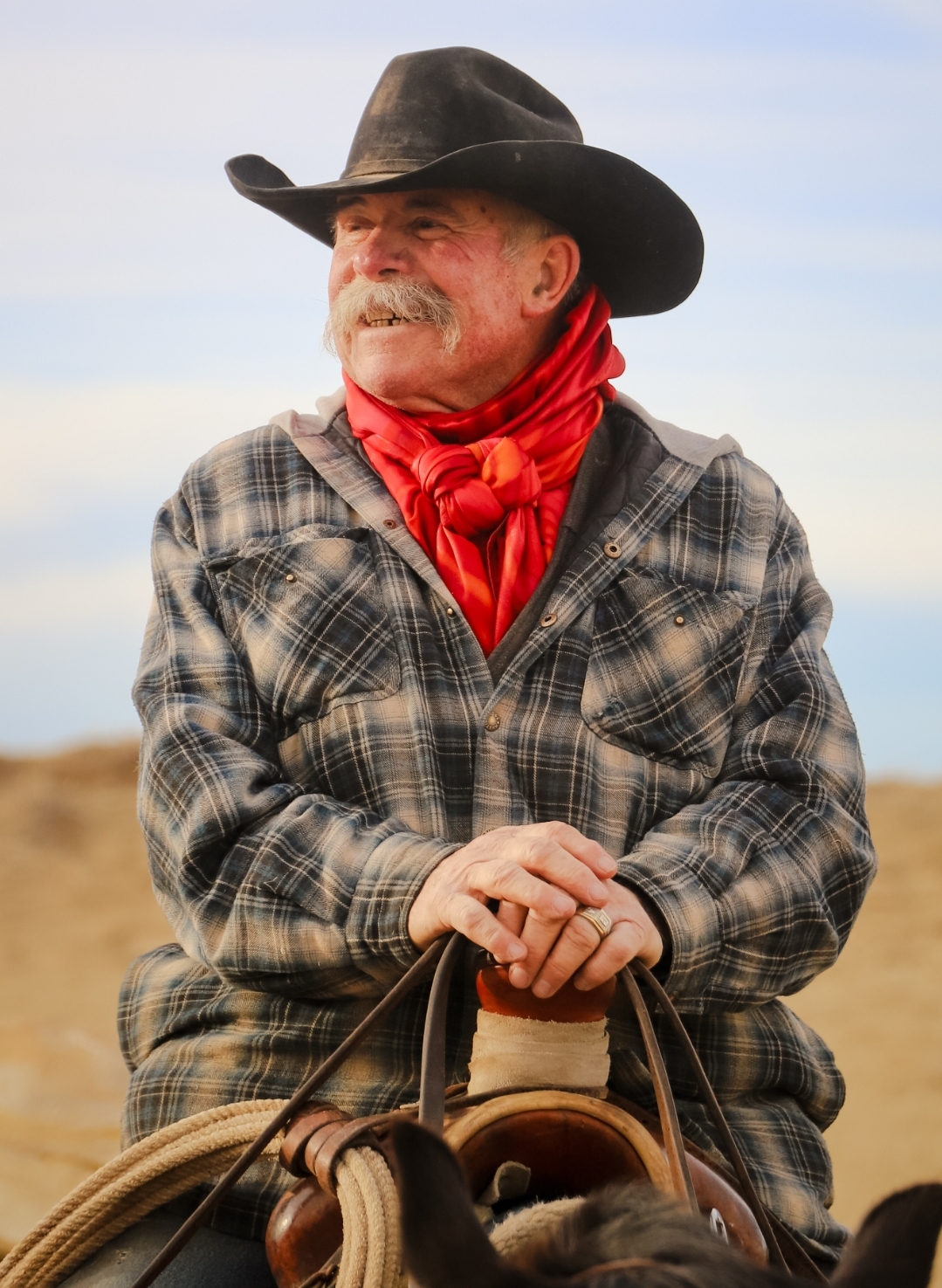
Earl “Tut” Camblin, born in 1950, as the oldest of three children, was his father’s right-hand man raising horses, sheep, and cattle. Tut started his first horse when he was ten years old. After graduating from high school in 1969, Tut took his dad’s advice and set out to cowboy for a living on other outfits, while still coming home to help his dad on the home place when needed.
Tut first set off for a job at the Wagonhammer for Bill Gibbs, northeast of Gillette. The Wagonhammer had sheep and cows. Along with working the sheep and cows, part of Tut’s job was starting older horses that fall and winter. The winter of 1969 Gibbs sent him to a cow camp on Bitter Creek north of Recluse, taking care of the 500 head of calves that had been weaned there.
After he left the Wagonhammer, he went to work for Nick Harris on Spring Creek north of Gillette. In the fall of 1970, he went to work for the LAK near Newcastle, riding in the feedlot and helping with the outside cattle as well. The feed lot had around 8,000 head of cattle in it. While at the LAK, Tut met his first wife TeDye, who became the mother of his three children.
Then Tut was needed at home so they left the LAK and came home to help his dad for a short period of time. After their son son TJ was born, Tut went back to work for Nick Harris at Horse Camp near Spotted Horse north of Gillette, taking care of all the weaned calves.
Tut then went to work for Herman Werner who owned multiple big ranches. Tut floated from one ranch to another and worked on them all until he was promoted to manager of the 55 Ranch north of Glenrock. Tut was taking care of 2,400 head of mother cows and 10,000 head of ewes. He was the only hired man there, except during branding, docking, shearing, or shipping when a crew would come in to help with the work. Tut did everything horseback. Tut would go to help Wayne Bowman down at the Bolton Ranch south of Rawlins. The Cherry Knob pasture had 96 sections in it. He said it took a little over a week to gather just the one pasture. They would ride out by 3 a.m. and not get back until after 10 p.m. They had to bed cattle down as it was too far to trail them. They had to cross rivers and ride in the dark a lot.
When the 55 was sold, Tut went to work for Van Irvine, who also had multiple ranches. Tut was hired on at the YJ west of Casper on Powder River. The spring of 1973 there was a terrible blizzard and Tut’s dad thought he had lost everything and needed help. So, Tut left the YJ and returned home.
After a short time at home, getting livestock located and everything taken care of, Tut took a job at the Taylor Ranch on Dry Fork of Powder River. While working at the Taylor Ranch, Tut’s daughter Tammy was born in December of 1973. Like the other ranches, the Taylor Ranch had both sheep, cows, and a lot of miles to cover horseback. His last ride at the Taylor Ranch was one of the longest, as he rode all the way home from there because the engine was out of his truck. He rode home to get his dad’s truck to go back and gather up his family to move home. Tut’s youngest daughter Tiffany was born in 1980.
After a time at home Tut took a job working for Dick Jarrard on the Dunlap Ranch, southwest of Laramie Peak on Cow Creek. They spent the winter there. He then spent time near Riverton, before returning to the home ranch.
Tut’s dad was getting older and needed full time help at home. Earlie had continued raising horses, a large flock of sheep, and small herd of cows. Earlie had purchased an AQHA sire named Kings Imp who was a King Ranch foundation bred sire. This was a smart investment to improve their horse program.
Over the years, Tut added select AQHA mares to cross on his AQHA sires. The legendary horsemen in his family had taught him what to look for when selecting horses for his program. Tut’s great uncle, whom he was named after, and who had taken a ship load of horses to China in the early 1900s once told him, “If you want big horses, you need big mares.” Tut also knew they needed to have cow sense, good bone, and balanced conformation. Tut is known for saying, “The feet are the foundation. Look at their feet first. If their feet aren’t any good, then there’s no sense in looking at the rest of him.”
In his own breeding program, Tut focused on “all around” horses. In late 1990s, Tut was taking in horses and riding them for BLS. He was working four days a week at the Keeline Ranch near Newcastle. which brought the family story full circle as his grandfather had worked for Keelines in 1900.
Tut always said, “The person who thinks they know everything, will never learn anything. We must always keep learning.” Tut died and was buried on the home ranch August 4, 2025.