

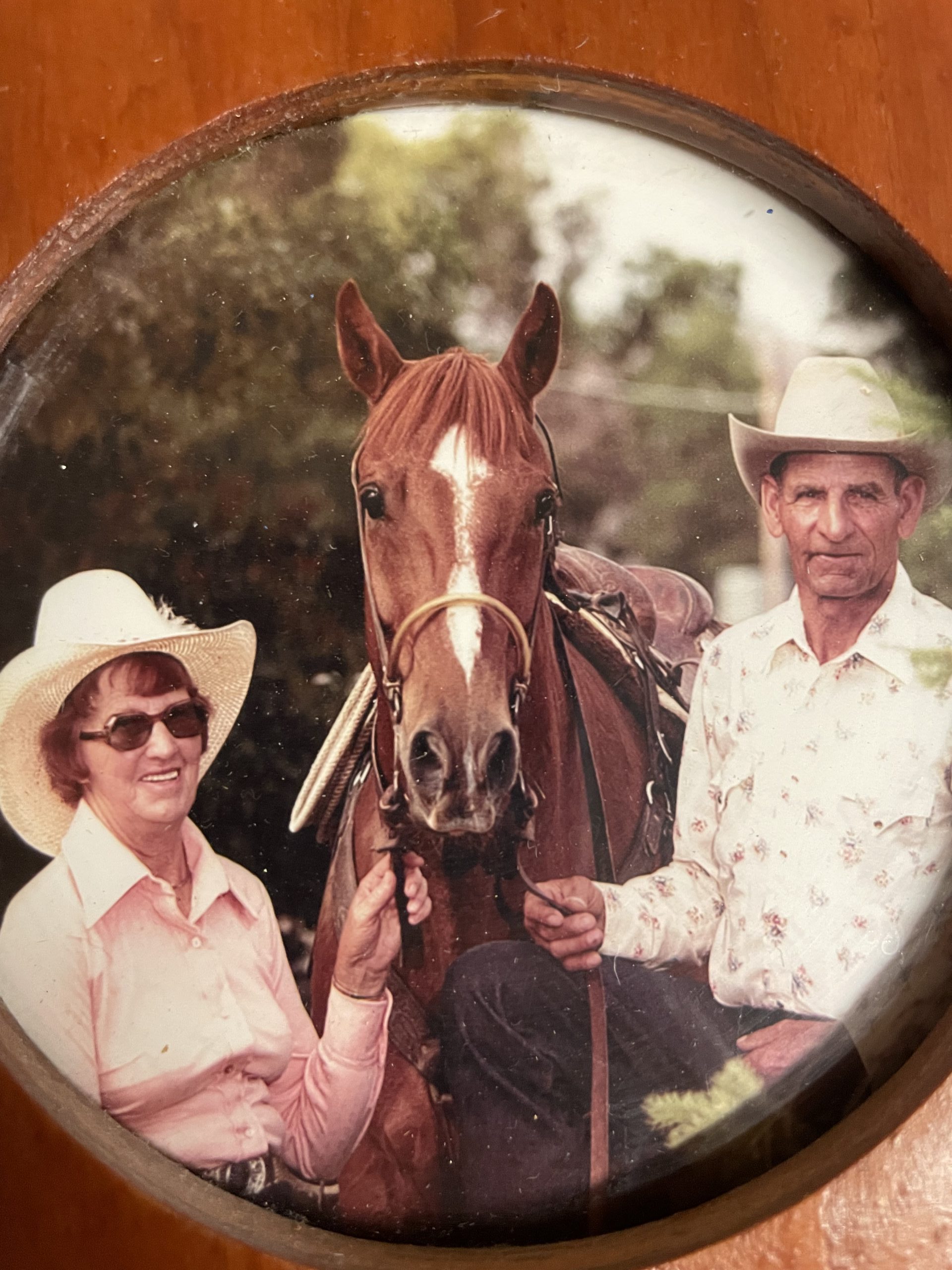
Doyle Slagowski was born in 1910 at Smithfork east of Mountain View and was the fourth of nine children. Shortly after his birth the family moved to Henry’s Fork, where his dad homesteaded.
He first went to school on Henry’s Fork. The schoolhouse was about three miles below their place and they went to school in a buggy or on horseback. He attended school there until he was in the fourth grade. His family moved to Manila, Utah, for one year. They moved back to Henry’s Fork where he finished his schooling at McKinnon. It was seven miles to school, and they went by wagon or horseback.
In the early fall of 1924, when Doyle was 14 years old, he got a job starting colts for a rancher. He started ten head of colts and put ten rides on them and was paid $10/head for his work. In the winters of 1928 and 1929, he carried mail from Mountain View to the halfway station at Lonetree.
Doyle got a contract to haul cement into Island Lake. When he got the contract, he didn’t have enough horses, so he went out on the desert and caught nine wild horses and broke them to pack in a short time. He would load them with 100 pounds of cement and tie them head to tail. He said that you could see them weaving in the back since they were not all that broke. After unpacking the horses, he would turn them loose and herd them back out after each trip.
In 1930-31 he worked for Dave Rassmasson at the Old Phil Mass Horse Ranch where he herded sheep, worked on the ranch, and broke horses. He went horseback with a pack horse to Lander, looking for work in 1932 and didn’t find any until he got back to Daniel. He put up hay and gathered horses in the morning for Si Kelly for $1.25/day with room and board.
He ran wild horses for Barney Kincaid south of Green River, in Fire Hole and Dry Creek. He and his brother Floyd started a bunch of colts and gathered wild horses. They got to keep half of the unbranded ones. They shipped them on the railroad in Green River and were paid $5/head which was six months’ worth of wages.
In 1934 ,he worked for Bill Lewis whose place was 20 miles north of Superior. During this same year he went to work for Ivan Dearth in Eden Valley, where he cared for cattle, broke horses to ride, and ran wild horses. He Made his way back to McKinnon, that winter running wild horses and working at Beaver Meadow Reservoir part of the winter.
From 1935 to 1936 he broke horses for Dave Rassmasson, ran wild horses, and began working for Lou Trovotton in Eden Valley, riding for cattle. He spent three months working on the railroad and said that it was the “worst job he ever had.” Following that he worked for Jim Ramsey on Little Mountain in Sweetwater County, breaking horses and running wild horses. Following this he went back to the home place and worked for his dad for a while.
From 1939 to 1943 he worked for Amm Nebeker of Manila, Utah, working cattle. On June 29, 1940, he married Fontella Potter.
Fontella Potter (Fon) was born in 1917 on the Wyoming/Utah state line to Timothy and Bertha Potter. She was the third of thirteen children and the oldest daughter of the four girls in the family. Fon started riding as soon as she was old enough to help her mom around the place. While her father was herding sheep for local ranchers, Fon was tasked with pushing the cows out to the Double Bridge permits where her family ran cows and horses. Each day they would ride from Washam and push the cows back out. The horses Fon rode growing up were wild mustangs that they roped out on the desert and broke for saddle horses.
Fon went to school at the Little Red School House in Linwood and finished her schooling at the Washam School House attending until the 10th grade. They rode to school every day while attending the Little Red School House.
Fon always had a love for horses and rode as much as she could, continuing to ride even when work was over for the day. Fon always rode what was available until she married Doyle. He always made sure he put her on the best horses he could make.
Her family ran cows and horses out on Double Bridge, the teams of horses out on the Dixon Ridge north of the Henrys Fork, and ran their sheep at the home place. They rode each day to bring the horses in from the creek, leaving one horse in the corral as a jingle horse to gather the horses each morning. They put their hay up with teams of horses and each kid had a job helping around the place since their dad was gone with the sheep in the summer range.
Fon met Doyle at the Burnt Fork dance hall, and they started courting after that. Doyle would ride from Ann Nebeker’s place to Washam to visit Fon. They were married in 1940. Following their marriage, they lived at the Horse Ranch on Cedar Mountain for two years working for Jack Ringdahl. During this time Doyle built the first dam on Ringdahl Reservoir with a team of horses. Since then, it has been replaced, but it was there for over 50 years.
In 1944, he went to work for Heber Bennion of Manila, Utah, for two and a half years then spent a year and a half working for Ann Nebeker followed by working for Jack Ringdoll of McKinnon. Following this he worked for Dick Bennett in Manila, Utah for eight years.
One winter shortly after Doyle and Fon were married they and her brother, Burl, lived on Bear Top cutting poles to sale and using horses to get them out.
In 1960, Doyle and Fon bought the homestead ranch in Washam, from Fon’s parents. They ran 34 head of cows. They raised five children. They rode nearly every day checking on cows. Fon and Doyle enjoyed running the wild horses. Fon loved to race her horse, Top, bareback in South Valley and she usually won. Doyle enjoyed team roping and Fon also barrel raced her horse. When they were older, they competed in the Old Timer Rodeos where Fon won among other things a nice breast collar.
They were 4-H leaders for the Sandtown Moon Riders 4-H club. They competed at the Sweetwater County Fair in many events and won numerous trophies and plaques, including being honored for that at the fair one year. Fon also helped judge queen contests for several years. She drove school bus for 26 years and Doyle worked for the Game and Fish as a trapper for five years. Doyle died in December of 1984.
Fon loved a good book and loved to play solitaire in the evenings after Doyle died. She was simple and basic, but loyal and loving to her kids and grandchildren. She served as the Grand Marshall of the Cow Country Rodeo in 1987 where she carried the flags and was honored while riding her horse, Misty. Additionally, at the age of 83, she was honored as the Cow Country Rodeo Centennial Queen. She was recognized at the rodeo and in the parade riding her horse, Frosty. Fon died in February of 2012.
Their granddaughter, Brynne remembers Grandma helping them get the cows out every spring. They would leave Henrys Fork and head up Dry Creek with the cows and Grandma would ride to the Mackey Place, cross over and go back to get the truck and pick them up at Dry Creek on Hwy 1. Grandma always came with drinks and something to eat because she knew that their dad would not have packed them a lunch.
When Brynne and Scott were young Grandma would ride with them every day, heading out across the creek below the house and pushing the cows back out to Joe Smith Springs in the summer. She cooked all the meals for them while they were haying and she was a big part of their lives because she lived next door.
On another occasion when Brynne was about five years old, she remembers riding at the arena above the house and her cousin, Brad, was riding Grandma’s horse, Misty. Misty bucked him off and Grandma got on Misty and really tuned her up then handed her back to Brad to ride. Grandma had to have been at least 70 years old at that time.
Doyle and Fon loved horses, their family and their way of life. They never had much, but you would never have known that. Their legacy of love of for horses and the cowboy way of life continues to be passed down through their children, grandchildren, and great-grandchildren.