

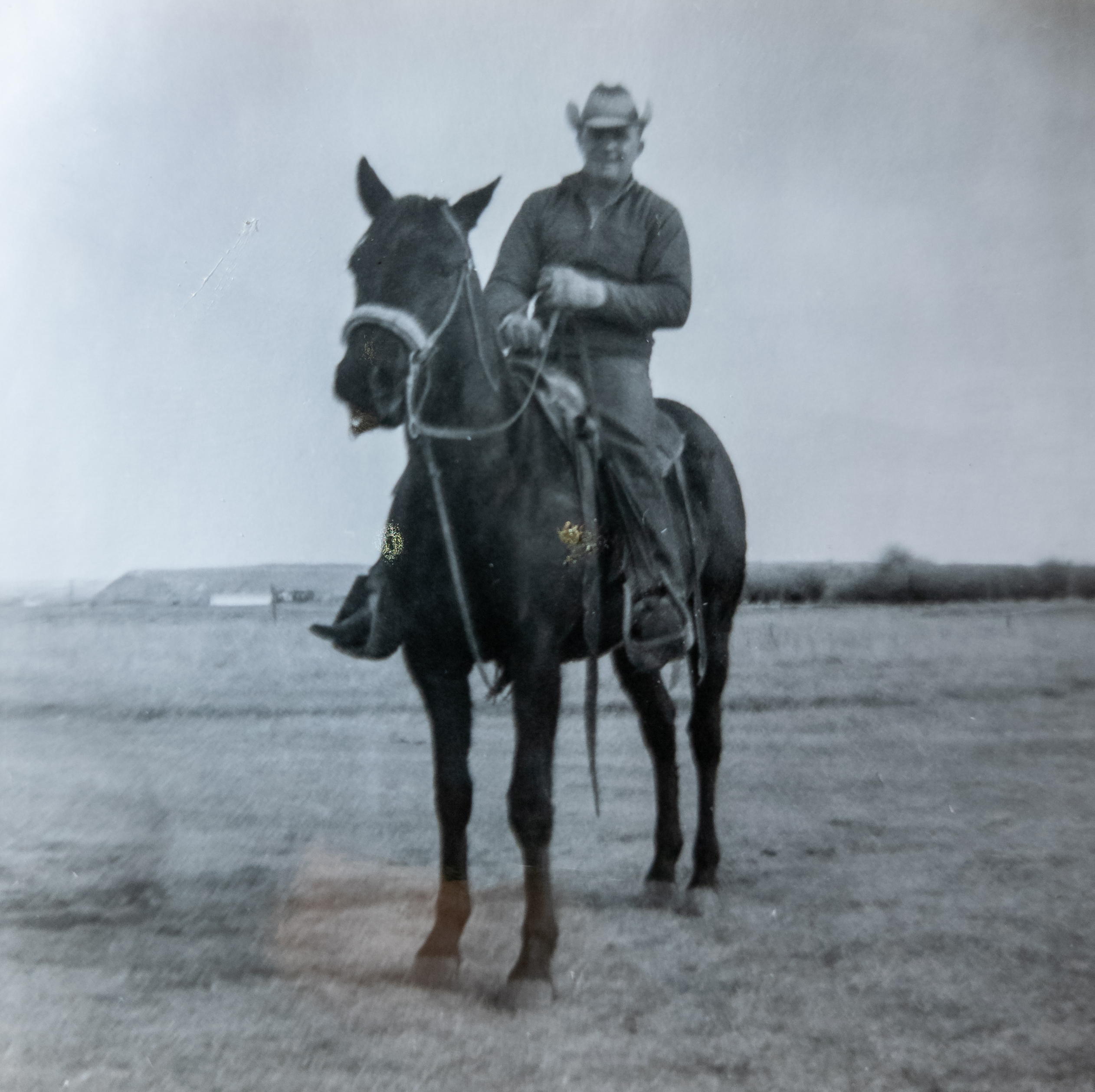
The title “Cowboy” gets tossed around far too freely these days, whether the person deserves it or not—but Clarence “Tuffy” Davis earned every inch of what that title truly means.
To earn it, a cowboy’s life isn’t defined by rodeos, owning a ranch, riding horses or dressing like one. It requires mastering dozens of skills, just to list a few: part veterinarian, and always a problem solver; repairing miles of fence, knowing every inch of the land to manage water and irrigation along with how the cows are grazing so range is not overgrazed, and preparing for both good years and bad. Being a cowboy isn’t just a title—it’s a lifestyle, lived every single second of every day.
What follows is only part of Tuffy’s story, shared by family, and paraphrased from a Sublette County Journal article (January 4, 2001) written by Helena Linn:
Clarence “Tuffy” Davis was born on a cold winter day, December 21, 1930, in a two-room house in Marbleton, to Clarence and Emma (Klein) Davis. His grandfather gave him the nickname “Tuffy,” a name that stayed with him for life. When Tuffy was two years old, his family moved to the Bootjack Ranch to feed cattle, living that winter in a sheep wagon along the banks of the Green River.
The family later lived and worked on the Sykes Place for thirteen years, employed by Bob and Mildred Miller. Tuffy attended school in a one-room bunkhouse on the ranch whenever a teacher was available. He started school at the age of five and was required to repeat first grade because he was considered too young.
Later, Tuffy and his half-brother, Charles Nelson, rode horseback to the Dan Budd Ranch to attend school for about three years. After that, they traveled by buggy or one-horse sleigh to the Springman Place, where several neighboring children attended school together. Tuffy often recalled that he and the other boys were skilled at finding reasons to spend as little time in the schoolroom as possible—roping colts that conveniently took time to unsnare, or searching for just the right straight willow while building a replica of Lincoln’s cabin, an excellent excuse to stay outdoors longer.
While his dad was working at Millers, Tuffy and Charles wrangled the horses. Tuffy would ride is horse in the bunkhouse around the pool table and wake the other hired men up. One Christmas Tuffy’s dad gave him a goat with a harness which he wanted. Then John Chrisman gave him a dog which he would hook up with the goat. When the goat got stubborn, he would sic the dog on the goat. He finally got a team of goats and a wagon. He would go feed with his dad along with hauling manure or whatever the chore was on the ranch.
In 1944-45, Tuffy and his dad went to the Circle Ranch and helped Ted Cantrell feed 1,000 head of cattle that winter. In the spring Tuffy and Clarence went to work for Charlie Noble. They moved cattle to the Hoback Basin from the Big Piney area and worked on the roundup in fall. Tuffy also worked for Logan Homer on his ranch, but his dad always worked it out so Tuffy could help drive the cattle to the Basin and he could do the roundup in the fall with them.
In 1947, Tuffy went to work for Buss Fear breaking horses they ran in from the desert. In the winter he fed the cattle with a team and sled. The next spring, Tuffy’s job was to ride Muddy Creek where the cows could easily bog down and get them out if they did, which he did for 30 days. He would ride from and back to the Fear place every day.
In the late 1940s, Tuffy rode with the roundup association. The foreman was Bill Budd, Sr. (a WCHF inductee) and the camp cook was Rod Bennett, Sr. Several young men gathered cattle from along the Green River and drove them to the drift fence in the Upper Bench corral allotment. They slept in tents and ate from a chuck wagon. Each morning, a cowboy selected a horse to ride by roping one from a rope corral—a task that was not always easy. Saddling and riding these untrained or spoiled horses often resulted in a bronc ride before the day had even begun. Tuffy rode the rough string.
During roundup, Tuffy and a couple of other young cowboys would sometimes ride the eight miles into town in the evenings to find a little fun at the bar. Many nights, they didn’t return to camp until around three o’clock in the morning—just in time for breakfast before starting another long day on a rank horse and a hard ride. Tuffy always said roundup time was his favorite.
Tuffy also participated in several of the Opal cattle drives, which occurred earlier in that era. He often said the drives themselves could be dull because the cattle had to be moved slowly to keep them from losing the weight they’d gained over the summer and early fall. But as they neared the stockyards, it wasn’t uncommon for a train whistle to blow and scatter the cattle in every direction. That, Tuffy said, was where the excitement started—usually accompanied by a good bronc ride in the middle of the chaos.
In the early 1950s, Tuffy and a couple of his friends decided to hit the rodeo trail, eventually making their way to Texas. They arrived flat broke and learned quickly how to survive—picking cotton, washing dishes, and even siphoning a little gas to make it back home to Wyoming.
Tuffy’s father, Clarence, Sr., leased the Norris and Fredell places. Tuffy then went to work for his parents and cowboyed and ranched on this place until he passed away in 2009.
Tuffy understood the culture of cowboy life, including the humor and traditions that bonded crews together. He often told stories of hazing the new hand. One favorite involved Bill Budd Sr.’s son, Bill Budd Jr., when he first joined the roundup. Tuffy and a few others convinced him they were going “snipe hunting” late at night, instructing him to stand in a creek holding a gunny sack while they scared the snipes toward him to catch. Of course, there is no such thing as a snipe—but Bill Budd Jr. didn’t learn that until later.
In the early 1980s, Tuffy underwent his first open-heart surgery. Just two weeks after returning home, he ordered his horse shod so he could ride the roundup. Something about the smell of horse sweat, dusty cow trails, and long days was his passion. Over his lifetime, Tuffy survived two more open-heart surgeries, recovering from each in much the same way—by returning to the work and the life he loved.
Clarence “Tuffy” Davis passed away on October 20, 2009, but the legacy he built did not end with him. The Davis Ranch remains in operation today and is still run by his daughter, Holly Davis, continuing the work, values, and way of life that Tuffy lived every day.
Tuffy Davis represents the kind of working cowboy Wyoming was built on. His skills, character, resilience, humor, and lifelong dedication embody exactly what the Wyoming Cowboy Hall of Fame exists to honor. He didn’t claim the title of cowboy—he earned it by living it.