

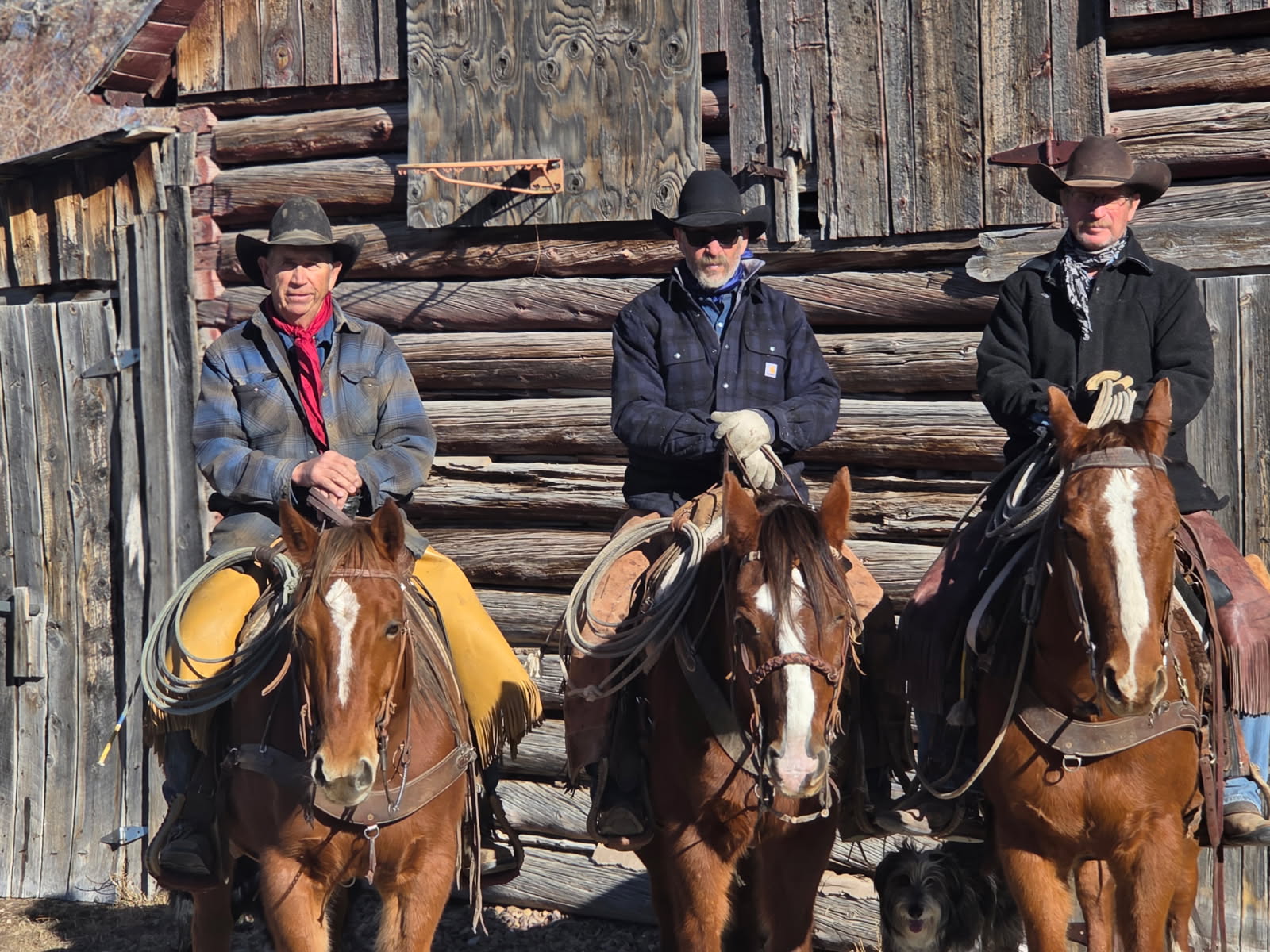
Mark, Bob, and Larry Anderson grew up on the Anderson family ranch on the Henry’s Fork near McKinnon, in Sweetwater County. They are 4th generation Wyoming stockmen. In 1917 their grandfather, John Clifton (Cliff) Anderson, and his bride Roena moved to their homestead east of Coons Hollow, now McKinnon. Cliff’s father, John A. Anderson, soon followed. Here they spent the next 29 years, raising 7 children and successfully running sheep and a few cattle. They bought the Henry Heiner place on the Henry’s Fork in 1946 and in 1954, Cliff established J.C. Anderson and Sons.
In 1964 Cliff and Roena’s youngest son Lloyd and his wife Francie bought the ranch. Lloyd was quiet, could fix anything, was good with a rope, broke his own saddle horses and always had two strong teams. Mark, Bob, and Larry began following their dad out of the door at a very young age, not because they had to but because they wanted to be a cowboy like he was
In the early years the brothers remember a major event for the family was trailing lambs from the Anderson’s Horse Ranch to the Green River railroad to ship. The journey was two days and nights in the sheep camp and forty miles. Being a few years older than his brothers, Mark spent the most time with the sheep. While in high school he spent some solitary time at camp, learning to “get up with the sun and sleep with the sheep.” His best friends were his horses and dogs. Their mother said, “They could all handle sheep well but no one taught them to like it.” So, while originally the ranch was primarily a sheep outfit, Lloyd and Francie fully transitioned to cattle as soon as they could.
The summer of 1977 brought tragedy to the family when their dad, Lloyd, just 46, was killed in a truck accident on his way home from the Fort Bridger rodeo. This calamity changed the course of their lives but the desire to be cowboys remained strong. And although they each took a different path to make a living; the common thread was to keep the ranch going, take care of their mom and live the life they loved. When asked how many years, they’ve been a cowboy, they collectively would say their whole life. They not only have all the necessary cowboy skills but embody the characteristics of the cowboy code; such as self-reliance, independence, honesty, courage, fortitude, loyalty and helpfulness.
Mark broke his first colt at the age of 10. It was an orphaned wild horse buckskin colt that showed up at the sheep camp with the herder’s horses. At age 14, a neighbor, LaRay Sadlier, gave him a three-year-old in trade if he would ride one for him. Through the years Mark would break colts for other neighbors but decided he could make more money by breaking his own and selling them. For many years he would try to ride two a year. Over the last ten years it has slowed to one and he says he doesn’t break young horses anymore but trains them.
At 20 years old Mark took on managing the Nebeker Ranch in Manila, Utah, just across the Wyoming border. Mark and his young family were there about three years until his dad’s death. Mark gave up what he felt was the best job anyone could have to move his family back to McKinnon in order to help his younger brothers and work the family ranch full time. However, it took outside work to make ends meet. Using his talents to produce trusted saddle horses, for many years he provided a string of dude horses for the Red Canyon Lodge on the Ashley National Forest. He also provided the stock and put on ropings for a little extra money. His only other outside job was as a brand inspector.
In 1987, he and his wife Wendy were named Ranch Couple of the Year for Sweetwater County. Today they live on the Henry’s Fork east of the original ranch house. In addition to training saddle horses, two teams he broke himself were his favorites. He broke and used them separately most of the time but there were special occasions where he would hook them up in a four-horse team.
In 1986 ,Mark was able to lease the Nebekar Ranch and in 2001 leased the Bob Gamble ranch on the Wyoming-Utah line from Bob’s daughter, Karen Lewis. Both leases were a “handshake deal.” Mark’s goal was to create a ranch big enough to employ family members who wanted the ranch life. Today Mark’s daughter, Kelly is doing just that. Mark says getting older is okay because the neighbors let him rope at all their spring brandings. (His rule: two feet, not one).
The ranch and cows were his priority but Mark is a talented team roper and rodeoed when he could. He went to the World Series of Roping in Las Vegas eight years and was in the money seven of those eight years. Twenty-three years ago, Mark helped start the Cow Country Jr. Rodeo series held once a week every summer in Manila, Utah. Over the years he has helped numerous young cowboys and cowgirls learn to rope and ride.
The first horse that Bob remembers particularly well was Cherry Pie. She was a Hancock bred pain in the pants that nobody wanted to ride because the last mile back to the barn was misery as she pranced and danced sideways. At the age of ten or eleven, Bob and his brothers were charged with taking 100 head of cattle the five miles from the ranch to the lower place on the creek without their dad. Lloyd would send them off and just let them figure it out.
During branding Bob also remembers wrestling calves until about ten or eleven and then earned a rope and started dragging calves to the fire horseback. About that same time, the brothers started gathering the desert and riding Cedar Mountain. Many days they would start before six in the morning and ride all day gathering cows, often until after dark. Food in the saddle bag is still optional.
In his early twenties. Bob rode saddle bronc in local rodeos, the Rocky Mountain Rodeo Association, and PRCA. He earned a spot in the North American Commission Finals two years in a row. Bob’s experience competing in timed events and rough stock has enabled him to be a fair and accurate judge at local rodeos today.
In addition to working on the ranch, Bob went to work for the BLM Wild Horse program. He was a wrangler for twenty-four years gathering wild horses and burros all across the western states. Many times, he would get up at three in the morning to drive to Rock Springs, work all day, and then work on the ranch when he got back home. Bob could get by some of the toughest saddle horses leased to the government and would run to a herd of wild horses, rope a stud just in time to have the helicopter fly over and set his horse off into a fit of bucking and still manage to get the stud back to the horse trap.
Horses were fun, but burros were smarter and trickier and he didn’t mind giving chase through a bed of cholla cactus. Bob took great pride in taking his adopted wild horses to ropings and beating the competition. One of his favorites was a horse named Speedy which was a wild horse he roped at Foster Gulch. The dark bay earned his name as he was quick, fast, cagey, and it took three days to get him caught. Speedy, was a go to for Bob and earned accolades at home on the ranch as well as at the county fair and at wild horse competitions.
After retiring from the BLM in 2006, Bob went back to being full time on the family ranch. He still runs cattle on Cedar Mountain and the desert halfway to Green River, Kemmerer, and Pinedale, plus leases ground wherever and whenever they need. Bob says there are “always cows to move.”
Bob enjoys leather work and makes chaps, reins, headstalls, breast collars, belts, knife sheaths. and pistol holsters for his back cinch. One of Bob’s greatest joys is teaching his grandkids to handle cattle, drive tractors, and ride horses. Bob and his wife, Stephanie, live close to his 94-year-old mother, Francie who still lives in the original ranch house.
Being the youngest of the Anderson crew, Larry came to cowboy life by following his dad and his brothers. If they could do it, he could, too. He learned to shimmy up a horse’s leg to get on, rope chickens, and ride a calf as it scrambled up after being branded. He received his first saddle at the age of seven. It was a gift that began hours in the saddle, as he rode it on the back of the sofa and countless miles horseback.
He cowboyed on the family ranch learning how to feed, doctor, care for livestock, and lend a helping hand when needed, in addition to riding and roping which became as natural as walking. At the age of nineteen he took these skills to his first outside ranch job where he managed the Cal Hickey ranch. That job led to life-long friendships and future ranch work.
Larry worked for a number of different ranches in Uinta and Sweetwater Counties. Whether at home or on another outfit Larry established a work flow that matched the season. During the winter, he fed hay from a team or tractor drawn wagon with a saddle horse tied behind, then rode through the cows to check cattle numbers, herd health, and water. In the spring, he spent hours on horseback monitoring calving.
Once calving was finished, he rode the “grub line brandings” at every outfit that would ask him, which kept him busy and well fed since he was one of the most sought-after cowboys in the valley. Summer brought long days in the saddle moving cattle from the home place to summer range, rotating pastures, irrigating and putting up hay. Fall riding was the height of the year as cattle were gathered and he enjoyed the sight of a uniform herd on shipping day.
Bud Huseman, passed on this wisdom, “Watch the boss and then just do it like he does” Larry would say “depending on the man’s corrals, he could get just as wild or just as calm and laid back.”
During this time Larry also took on five or six outside horses each year to start. He appreciates the challenge of a horse with spirit; one that may test him throughout the day. The thrill of the buck led him to join the Rocky Mountain Rodeo Association (RMRA), the Western States Rodeo Association (WSRA), and the Professional Rodeo Cowboys Association (PRCA). Scoring 92 points on Bluebird, riding at the Denver Stock Show and Rodeo, competing in Madison Square Garden. and getting 2nd in the rookie bronc riding at the Cheyenne Frontier Days Rodeo were the highlights of his years on the rodeo circuit.
Larry is a career cowboy who feels himself privileged to have worked for and alongside ranchers who he believes are iconic giants of the industry. He and his wife, Anne Marie reside in McKinnon just west of the original home place, where they raise Angus/Saler cross cattle.
Larry began his cowboy life by grabbing his hat and following his dad out the door. These days he is being followed by the next generations of nieces and nephews. Larry’s gentle guidance has given these cowboys and cowgirls a fondness for the western ranch life. As one of his nieces would say,” he is punchy.”
When their dad died, he had about two hundred cattle with the BLM permits needed for that number. Since then, the Anderson Brothers have been able to increase their BLM permits and add additional ground. Their permits are primarily on the Cedar Mountain allotment, a 225,000-acre common allotment with a capacity of 2,200 head. It has six pastures and cattle have to be moved at least once a month; taking three to five long days in the saddle per move. Between all three brothers, they now run over 1,000 head. On most days, especially during the fall gather, it’s not unusual to ride two circle horses per day and one sorting horse in the afternoon.
Mark, Bob and Larry have all spent their lives in the saddle. They all do their own farrier work and many times their own vet work, which is necessary being so far from town. They can all hitch and drive a team and take on any job at a branding.
The high desert country where the Anderson brothers run cattle isn’t country you can use a 4-wheeler to move cattle from one pasture to another in just a few hours. It’s cowboy country. It takes long days in the saddle and much attention to the available feed and water, being careful not to overgraze. They have the cowboy skills needed to rope and load a bull or doctor a big cow in the pasture, where any corrals are miles away.
When so many family ranches have been sold, the Anderson brothers have managed to keep J.C. Anderson and Sons ranch in the family. They all credit their mother, Francie, for being the glue that held things together. Almost 50 years after his death, their dad Lloyd would be so proud as would their grandfather and the entire Anderson family.