

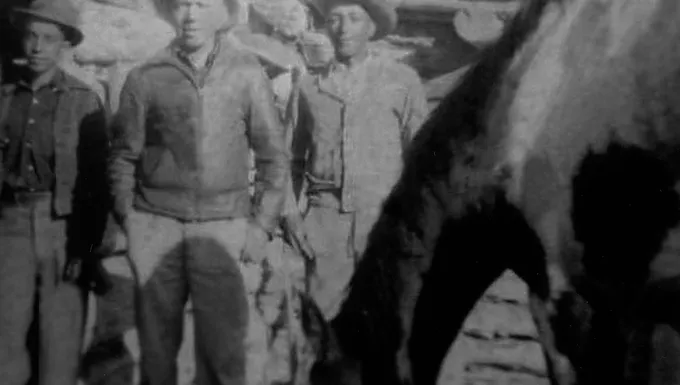
Alonzo, John Fee, William Gary, & Horace Greeley “Dutch” Stepp
Lon Stepp’s early life was as the son of a slave in Kentucky, but he moved to Wyoming to become a cowboy. His sons also took up cowboy work in Wyoming. The family eventually had a 2,000 acre cattle and sheep ranch that was later engulfed by Fontenelle Reservoir.
Alonzo Theodore “Lon” Stepp was born September 20, 1874, in Berea, Kentucky, the son of former slaves Archie Stepp and Anne Blythe Stepp. Archie was the son of a slave and a mixed-race woman
At a young age Alonzo, or Lon, as he was commonly called, realized that an education was very important. He worked hard to learn to read, write, “sums” and acquire as much of an education as possible. He asked for help, begged materials, and studied whenever possible. All of this hard work eventually paid off as he was accepted at and attended Berea College starting in 1893 and graduated with a degree. It was while he was attending college that he met and later married Esther Jane Yates, daughter of Harrison Yates—a former Lieutenant in the Union Army, in 1893. Lon and Esther had three sons, John Fee, William Gary, and Horace Greeley “Dutch” plus four daughters, Helen, Nellie, Ruth, and Grace.
Lon also met Howard Embree at College and they became close friends. Embree’s oldest sister and brother-in-law, Charlie and Nellie Rathbun, lived on Fontenelle Creek in Wyoming. Howard approached Lon about traveling to Wyoming in 1893. The two young men were to spend the summer on the Rathbun Ranch learning ranching skills, but Lon became so proficient at the job of cowboying that he decided to stay on the ranch and leave college. He became a top hand and became responsible for the day-to-day operations of a large ranch, which had cattle and sheep, eventually becoming his employer’s sheep foreman.
He began to build a small nest-egg, with the idea of going back east, getting Esther and family, and returning to “The Fontenelle.” Old man Rathbun told Lon that he would help get livestock and money for Stepp to start his operation. Lon wanted to raise his family in Wyoming where people were friendly, caring and he hadn’t experienced the racism as in the South. It took Lon three years to save enough money to be able to move back to Wyoming and support the family.
Once back in Wyoming about 1898, the Lon Stepp family lived at Opal and Lon resumed working for Charlie Rathbun as his ranch foreman and barbering in Opal. On the 1900 census, Lon was a sheepherder. Lon filed on a homestead just south of the confluence of Fontenelle Creek and the Green River. Lon did not prove up on his homestead, but his parents also came to Wyoming and Archie Stepp filed on June 25, 1900, and received a patent for a 156.28 acre homestead on December 5, 1907. He then filed on August 28, 1901, and received a patent for 69.88 acre Desert Land entry on February 13, 1908.
After filing on the land, Lon worked for Rathbun in which he had to ride 15 miles horseback to work every day along with taking care of his own little band of sheep. Eventually, Rathbun purchased more sheep and need to graze them around Montpelier, Idaho, so Lon would go “on trail” for months at a time, leaving his small spread in the care of the two oldest boys, John and Bill.
In 1912, Lon purchased the land from his father, and enlarged the ranch by 750 acres when he purchased Daniel and Alice Robertson’s land in 1922. Another increase took place in 1931 when he purchased 789 acres from Stayer and Jenny Richards. There were slim years for the Stepps as Lon would travel 15 miles on horseback to the Rathbuns for paying work. He would take his wages in both cash and livestock, starting with a small band of sheep.
To make ends meet, Lon was a brand inspector in the early 1900s, hired out with his teams of horses and good teamster skills to maintain the county roads, and served as assistant Lincoln County assessor, and postmaster for Fontenelle. At the time, Lon belonged to the Wyoming Stock Growers Association. He was the only African-American member. Lon preferred raising cattle to sheep because he believed cattle were more economically profitable. Lon Stepp of Fontenelle had the brand Quarter Circle U Hanging L or Tub on the left rib of cattle and left shoulder of horses listed in the 1916 Wyoming Brand Book with an overbit in left ear and underbit in the right ear. Lon was now from Kemmerer in the 1946 book. This brand was not in the 1956 brand book.
Having attended the Christian based Berea College and studied some theology Lon felt it important that his family maintain their Christian lifestyle. Neighbors came to attend Lon’s Sunday services as well. Lon also wanted his children to have an education, so when they first moved to Wyoming Lon and Esther taught them in their home. Later, Lon built the Stepp-Olson School house which was half way between the Stepp and Churndash ranches. John and Bill finished eighth grade in the one-room, log school house. Dutch graduated from high school in Kemmerer.
Alonzo T. Stepp was appointed Postmaster of the Fontenelle Post Office from September 3, 1920, until December 15, 1941.
While Lon was the brand inspector, he had one notable adventure. Some gentlemen rode through wrangling a string of horses and failed to get on inspection. When Lon found out that the horses were stolen and had “slipped through his area,” he headed out after the men. It took him a week to accomplish this and place them securely in jail and return the horses to their rightful owner.
Lon liked to bunch rope wild horses. Lon would round up wild horses form the desert to get horses for work on the ranch and broncs for rodeos. One time he saw a buckskin horse that caught his eye. He took down his rope, roped the buckskin from his saddle horse. The saddle turned, dumping Lon and his saddle to the ground. The buckskin and his rope were never seen again.
Lon was known to be quite a bronc rider. Don Studt told the following story about him: “Yep, old Lon was quite a man. He could out ride and out shoot just about anyone. One time some young twerps decided they would get the best of Lon, so they planned a riding contest for the next gathering. Each one of those youngsters picked out a soft bucker. Ole Lon was getting the wildest bucker. Ole Lon just sat up there and let ‘er buck. He rode that horse for quite a while and then jumped off, swept off his hat and took a bow at those youngsters. I don’t think they ever challenged him again.”
Bill recalled his father speaking of Butch Cassidy, the outlaw whom Lon knew personally as he would sometimes ride to the Butch Cassidy camp for an evening meal. Lon described Butch Cassidy as tall, Slender and very nice looking, handsome in fact, with a pleasing personality.
Alonzo “Lon” Stepp died December 15, 1941, in the Lincoln County Memorial Hospital after being in the hospital for two weeks and in failing health for several months.
John Fee Stepp
John Fee Stepp was born July 10, 1896, in Berea, Kentucky. He came with his parents, older sister and younger brother to Wyoming where they started ranching and cowboying until the government took the ranch away. John married Christine Tandy, who was from Los Angeles, California, and a mail order bride, on July 12, 1944 in Kemmerer. They had three girls, Mary Helen, Vivian, and Martha.
John not only worked on his father’s ranch and cowboyed but also worked for Lyon Rathbun. Once the ranch was up and running with cattle, the Stepp children would spend their entire summer caring for the stock on the summer range. Two children would stay with the cows. Two would move them to new grazing areas, set out salt and protect the calves from coyotes, mountain lions, and other predators.
John F. Stepp of Fontenelle had the UT brand which was to be on the left rib of cattle and sheep along with the left shoulder of horses in the 1916 and 1919 Wyoming brand book. There was no earmark. This brand was not in the 1927 book. In the 1936 brand book, John had the Upside Down, Reverse, Connected F Lazy S Slash which was on the left rib of cattle and left thigh of horses. The earmark was an underbit in the left ear and overbit in the right ear. In 1946, he was living in the Kemmerer area. John received his patent on a homestead of 130 acres along the Green River in Sweetwater County on October 14, 1924. It is located near the Seeds-Ke-Dee National Wildlife Refuge today. John Stepp was also a member of the Wyoming Stock Growers Association.
John was a good bronc rider. According to John, he was better than his brother Bill at bronc riding and roping, but according to Bill he was better. Even though John and Bill worked hard on the ranch, they found time to go to rodeos on ranches and nearby towns. John took top honors at Big Piney one year. John and Bill both enjoyed bareback and saddle bronc riding as well as roping in rodeos. It appears John’s favorite event was the wild horse races. Bill would bite on one of the horses’ ears as the mugger and John got accustomed to being the first rider to cross the finish line with would horse races.
Riding broncs was more than just a side hobby for the Stepp boys; they were paid $15 a head for breaking other ranchers’ horses, a job that usually lasted about a month. Stepps had a work horse which went to bucking and could not be used. Stepps would lead him to Big Piney to the rodeo grounds south of town, so they could buck him at the rodeo. No cowboy rode the horse called “Step and a Half.” When the horse was done bucking, a Stepp would walk out in the arena, catch him and lead him home. John was also a brand inspector in the 1950s.
In 1963, the government forced the Stepps off their land in order to create the Fontenelle Reservoir. Stepps had 500 Hereford cows and bulls with nearly 2000 deeded acres and some government lease ground. John and his family moved to Los Angeles, California when this happened where he died on April 21, 1983.
William Gary “Bill” Stepp
William Gary “Bill” Stepp was born September 18, 1898, in Berea, Kentucky. He came with his parents, older sister, and brother to Wyoming where they started ranching and cowboying. Once the ranch was up and running with cattle, the Stepp children would spend their entire summer caring for the stock on the summer range.
Billy Stepp’s of Fontenelle brand of Quarter Circle 7 Quarter Circle on the left hip of cattle and left shoulder of horses was in the 1916 Wyoming brand book. There was no earmark In the 1927 brand book, there was an earmark of a swallow fork in each ear, by then Billy Stepp was listed as being from Kemmerer. Bill married Geraldine Ruth “Gerry” Mason Lomax, who was a mail order bride, on February 28, 1948, in Detroit, Michigan. Their children were Jane Lonice and Yvonne Ruth.
Stepps were known for their hospitality. This hospitality was returned when Bill became lost while moving cows to the dessert. His father had sent him off with a reminder that if he became lost to look for the familiar landmark—Ft. Hill or turn his horse’s head loose so he could bring them home. As with all 14-year-olds, Bill rode off sure it was just another day. He rode farther and farther in to the desert. A group of Indians were camped, so when he became disoriented Bill rode into camp and asked questions. They told him they would take him back home, but not until the next morning. Bill was one happy boy when they rode into the ranch.
Bill got lost again running horses with his brother John and a neighbor, according to a story in the book, Black Cowboys by Paul Stuart. “Bill and John went to help a neighbor run in some unbranded horses, so the neighbor would have more horses to work on the ranch before Bill was a teenager. The neighbor rode out on one flank, John on the other keeping the wild horses moving towards the neighbor’s corrals. Meanwhile Bill rode drag pushing the horses forward between the flanks set by the other riders. The horses fanned out and Bill lost sight of the others. The horses went into a deep canyon and after several unsuccessful tries to push the horses further, he decided to head for home. As he rode on for hours, nothing looked quite right. He remembered his father’s works, “if you ever got lost just give the horse his head and he will take you home.” Bill gave it a try but the horse kept turning around heading him in the wrong direction. The sun began to get low in the sky and the horse needed persistent correction. Finally, he came to a creek. He was hot, tired and parched. Looking for a good way to get down a steep embankment to the water he noticed two coyotes following him closely. There was no way he was getting off his horse with those scavengers on his trail. It was getting dark when he noticed a campfire in the distance.
“Excitedly he rode toward the light expecting to find cowboys, water, some food and directions home. As he entered the camp despair filled his chest once again because this was an Indian camp. As it turned out they were surprisingly friendly and spoke English, too. The natives gave him water and a can of tomatoes and offered him some jerky. Hearing that Indians ate their dogs, he decided to respectfully decline the jerky. They gave him some blankets to bed down with. Bill was grateful for the Indians’ hospitality, yet he slept little as it rained most of the night. Early the next morning the Indians gave young Bill directions to Green River City, unfortunately he lived at the Green River settlement, which was in the opposite direction. The Stepp family, alarmed that Bill never returned, set up a search party and rode out looking for him. Before Bill arrived in Green River City a passerby recognized him and rode with him until he could put him on a trail that led straight to his home. The family was obviously overjoyed to see Bill, notwithstanding Lon gave him a stern impromptu lesson on giving your horse his head as soon as he heard what happened.”
One summer, Bill was to help his dad maintaining the roads by driving the teams of horses on the equipment. Bill was expecting to be paid, but no mention of money was ever made. Being a determined young man, Bill decided to take matters into his own hands. He got out the Sears & Roebuck catalog and placed a C.O.D. order for one saddle. After the deed was done, he did worry some but was scared to mention it to his father. After some time, the long awaited “pay” did arrive. Lon paid the C.O. D. charges, handed the package to Bill and said, “I believe this is yours.” Bill said he was glad to have the saddle, but even happier that nothing more was ever said.
In 1963, the government forced the Stepps off their land in order to create the Fontenelle Reservoir. Stepps had 500 Hereford cows and bulls with nearly 2000 deeded acres and some government lease ground. Bill was a member of the Wyoming Stock Growers Association until he retired from ranching and served on the Board of directors of the Association along with being a member of the Federal Land bank system, and the Douglas County Farm Bureau.
Bill and his wife Geraldine helped the Black American West Museum and Heritage Center in Denver, Colorado, when it developed exhibits on the Stepp family being black homesteaders and for a Black Cowboys in the West exhibit. Later, the museum talked to other family members. Bill and his family moved to Denver, Colorado where Bill died October 19, 1980.
Horace Greeley “Dutch” Stepp
Horace Greeley “Dutch” Stepp was born April 16, 1912 in Fontenelle, on the Stepp Ranch. Once the ranch was up and running with cattle, the Stepp children would spend their entire summer caring for the stock on the summer range. Dutch married Carolyn Hill, an area school teacher from Superior, on in January 14, 1938 at the Stepp Ranch. Their children were Eleanor, Jean, Gary, Larry, Mary Helen, and Brad.
The Stepp family lived in a log cabin home and was lucky enough to own a lovely organ, which was a rarity at the turn of the century for struggling ranchers. The whole family loved music and Dutch took to playing the organ like a duck takes to water. He started playing before he could hardly talk or reach the pedals. No one could understand his excited words as he started to play, so they said he was “speaking Dutch.” That has been the name he has carried through his life, along with this continued and memorable talent and unique style on the piano. All three Stepp boys were musicians and played for dances throughout the Green River Valley for many years. At first there were known as “The Stepp Family Jazz Band.” Later they were joined by Ralph Armstrong and were called “The Stepp and Armstrong Band.”
Dutch had to take the sheep down to Opal to the railroad. On the way, a blizzard came up, but Dutch continued on until he reached the stockyards in Opal. After putting the sheep in the pens, Dutch went into the Opal Merc, bought a pair of long underwear and put them on immediately. Petrie, the store owner, put the story in the local newspaper razing Dutch and not making Dutch to happy.
In the 1956 Wyoming brand book, Horace Stepp of Fontenelle had the Bar PJ on the left rib of cattle and left shoulder of horses with two underbits in the right ear. Horace was from Kemmerer in 1966. After the government forced the Stepps off their land in order to create the Fontenelle Reservoir, Dutch moved his family to LaBarge where he was employed as custodian at the LaBarge Elementary school from 1966 until he retired in 1982. Horace Greeley “Dutch” Stepp died February 17, 1989, at the Sublette County Retirement Center in Pinedale, Wyoming.
Scotty D. Utz wrote a paper, “Steppin’ Up: An African American Family rooted in Wyoming Agriculture”, about the Stepp family cowboying and ranching in Wyoming as African American cowboys which was used to help set up the curriculum at the University of Wyoming’s College of Agriculture in 2006. The course that was developed was called “Agriculture: Rooted in Diversity.”. It was a course model for infusing Multiculturalism into the curriculum.
The government forcing the Stepp family off of their ranch ended the only Green River Valley African-American’s cowboying career after nearly 65 years.