

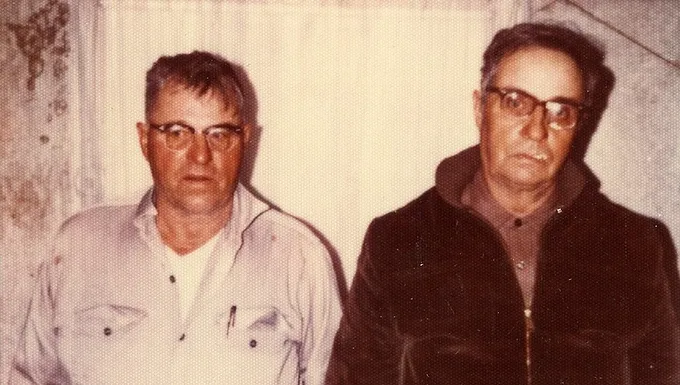
Alex 1873 – 1951
Clay 1908 – 1976
Doug 1909 – 1993
Alex Price and his two oldest sons, Clay, and Doug were very good cowboys and did a great deal of cowboying during their lifetimes. Alex was a charter member of the Upper Green River Cattle Association and ran his cattle in the upper Green River area as early as 1904.
Alex Price
In 1886, when he was only 13 years old, Alex Price came from St. Joseph, Missouri, with his father and sister. In 1891, Alex Price’s sister, Lillie, married John McNish, who was from Wisconsin and had a ranch on LaBarge Creek. Alex and Lillie’s parents were Joseph and Elizabeth Matt Price, from Ireland. Alexander L. Price was born April 1873 in Missouri. Alex’s father, Joseph died at Alex’s cabin on the Green River in 1903, at the age of about ninety-one.
Alex Price was a very good horseman and cowboy. Alex was known for his horsemanship ability and ability to ride tough horses. Bud Sommers, whose father passed away when he was 13 years old, said, “I learned much of my ability to work with horses and work cows from Alex.” Alex worked for William Graham on Slate Creek, the Spur Ranch on LaBarge Creek, and rode for the Big Piney Roundup Association in the late 1800s.
During the Equalizer Winter of 1889-1890, Alex said when the cattle died in the lane between Big Piney and Marbleton, they were so thick you could hardly ride your horses through it, and on the desert, you could walk from Big Piney to Green River City and never step off of a dead critter. Alex told his son, Doug, when he was riding for the Big Piney association in the fall or winter on Forty Rod flats, he and the other riders used a team to pull a sled for the chuck wagon. The team played out because of deep snow, so the cowboys had to camp. When Price went to get the camp meat it was frozen, so he had to chop it with an ax.
When Alex was living in the trapper’s cabin on the Green River, the Indians had a horse they couldn’t ride, so they got Alex to ride this horse. Alex said, “That was the damnedest bunch of pickup men you ever saw. They took off after me when that horse was bucking saying, ‘kiyiyi.’” They gave him some buckskin gloves for riding the horse. The Indians would camp with Alex because they liked him, and had him break horses for them. Palwaggi, with his four women, wintered on Alex’s place in 1890.
The trapper cabin was on the main trail up and down the Green River. Alex would have overnight visitors quite often. Charlie Bayer stayed with Alex in 1893. Butch Cassidy and his gang came through the country, and stayed with Alex, too. Alex had to homestead land north of this cabin because the cabin was on a school section. He filed on land in 1904. Before the association was formed Alex ran his cattle with the Green River wagon and did lots of the riding up the Green River.
The Pinedale Roundup reported Alex Price gathered his beef with Jense Cowdell and Albert McNish and headed to Opal going past Burns Post Office on October 13, 1904. In 1905, the paper reported Alex and Jense Cowdell had quite a time getting their cows together on the roundup, and in September Alex, Cowdell, and Willie Woods gathered their cattle to put in their fields.
A.L. Price of Burns, applied for his first forest permit on February 15, 1906 for 100 head of cattle and 5 horses with the brands of Bar 7, Open AP and Bar Diamond to be run between May 1 and October 31, 1906 in the East 1/4 Twp. 36 north Range 110 West and Twp. 37 North Range 109 West. In the May 9, 1906, Pinedale Roundup, Alex Price had the Bar 7, Bar Diamond, Open AP, and Double Half Circles brands listed for the range from the Forks of the River to the old log camp. When the editor of the Pinedale Roundup came to visit Alex in October 1906, he was gone to the road with a drive of beef.
About October 15, 1907, A.L. Price along with William Sutton, L. H. Hennick, Jense Cowdell, and William Rausan Adams trailed some cattle to Lander or Hudson to put them on the train when a blizzard hit. The cows were buried in the snow, which had covered them as they stood in the willows near South Pass City. Kids from South Pass City, including Bill Carr, skied around and poked sticks through the drifts to find live cows.
On July 21, 1908 according to the Pinedale Roundup, Alex Price, William Woods, Jense Cowdell, and Redmond Poole returned from the roundup. Alex lost a pack horse gathering beef on time, so he called the town of Daniel and said there should be a horse coming through with a pack on its back. An hour later, the horse was found, standing at the gate by Price’s house.
In 1927, when school sections were put up for sale, Alex bought the school section where the trapper’s cabin was located for $12.50 per acre. This was considered an outlandish price, since people could still homestead, so not very many school sections were bought. In 1913, Alex bought the Hugh and Sarah Martin homesteads which bordered “The Bootjack” Ranch.
Alex was a charter member of the Upper Green River Cattle Association, and ran his cattle in the upper Green River area as early as 1904. Alex and Mary Woods were married on December 9, 1907. They had three sons, Ellis “Clay,” Clarence “Doug,” and Alexander “Bill.” Doug and Bill lived on the ranch with their parents. Clay had his own ranch on Cottonwood Creek. All three boys were also very good cowboys. Mary was a really good cook and housekeeper.
Alex roped a wolf in 1918, when Martha Sommers was in first grade. As Martha looked out the door of the Price-Sommers School, she watched Alex open and close the wire gate, while his horse kept the rope tight so the wolf could not get away. Martha said it was something to watch the horse work the rope so Alex could open and shut the wire gate. He hung the wolf from the brace pole on the top of the corral gate. Alex Price died on September 29, 1952.
Clay Price
People who knew Clay said he was honest, tough, and hard working. “[He] was a wonderful guy,” observed Chuck McWilliams. “There’ll never be another like him.”
Born on the 31st of August 1908, in Kemmerer, Clay was the oldest of three boys born to Alexander and Mary Woods Price. Clarence Douglas (Doug) and Alexander (Bill) Price were his younger brothers. Clay attended classes at the Price-Sommers School located on his father’s homestead by the Green River. He went to school through the eighth grade whenever a teacher was available, but Clay didn’t care how erratic his schooling was. He skipped classes whenever he got the chance to help his father in the field. Besides, he didn’t think he needed schooling to be a cowboy.
He wasn’t very big when he received a saddle for Christmas. Because his parents had wrapped the present in a burlap bag, Clay immediately knew what it was. He began shaking so hard that he could barely get it out of the sack. He was an outdoor boy right from the start. Sometimes his mother would search frantically for Clay, calling his name over and over. When she was finally able to spot him, she’d ask why he didn’t answer. Clay simply replied, “Well I could hear you.”
Clay was not only an outdoor boy, he was “all boy.” One Christmas, Mary, to ease her disappointment at not having any girl children gave each of her boys a doll. “Mr. Clay,” she said, took his doll outside, soaked it with water from the pump, and then took the ax and chopped its head off.
Clay began to realize his dream of being a cowboy when he was only in his teens. He got a job working for the Upper Green River Cattle Association looking after cattle in the summer. He was the rough stock rider for six years. He stayed with that job until 1943 when he became the horse wrangler and guide for the GP Bar Dude Ranch. The ranch was located at the head of the Green River and was owned by Mr. and Mrs. Stanley Decker.
Clay first met his wife-to-be, Nora Whitaker, while she was working at the Decker’s home in Salt Lake City, Utah. She answered the door “and there,” said Nora, “stood a rough looking guy who asked for the Deckers.” They didn’t meet formally though until Mart Wardell introduced them the following summer where Nora was now working on the same dude ranch as Clay, helping to cook and clean for the guests. Later Clay teased Nora about being so scared of him the first time she saw him that she only opened the door a crack.
On December 1st, 1938, the couple was married in St. John (now Rush Valley), Utah, by Nora’s uncle, Willard Sagers, who was Bishop at the time. They then moved to a cabin on the Price’s upper place where Clay worked for his father for seven and a half years. Clay also leased the Jason Redfern field, a sixty-acre place adjoining Price’s upper field and was able to build up a small herd of cattle. He was anxious to have a ranch of his own, however, and when the Delbert I. (Herb) Fleming’s place came up for sale on Cottonwood, Clay sold most of his cattle to make the down payment. He leased Herb’s cattle and got two thirds of the beef check and two thirds of the increase at the end of the lease.
“Cattle Prices were high,” Nora reflected, and they got Herb paid off in a few years. Clay was known as one of the top cowboys in the country. Stories are told that there wasn’t a horse he couldn’t ride. Bud Sommers said, “If the horse couldn’t get Clay off on the first jump, the horse just as well quit right there.” Ted Morris said Clay could get on any horse and make him work. He rode broncs, roped, calved, and broke horses for other ranchers. His hard work and dedication resulted in the ranch Clay and dreamed of along with a fine herd of primarily Hereford cows.
After Dean Jewett was no longer president and roundup boss for the Rye Grass (BLM land) and Sherman (Forest Service land) Associations, Clay Price became the roundup boss and president until the associations ended. Clay and Nora raised six children: Charles, Raymond (Ray), Marianne, Marvin, Joseph (Joe), and Lee, yet they were completely free of debt before his death on July 11, 1976. Remembrances of Clay by the people in this area have yielded many an intriguing story. Here are just a few of them:
Stout as a Bull
Dick Noble claimed that his father, Carroll, described Clay as “stout as a bull.” If the horse didn’t behave, Clay was stout enough to teach the horse a lesson. He’d force the horse over, making it hit the ground with a thump. Chuck McWilliams and Clay rode for the Green River Association. “At one time we had a hundred and twelve horses in the Green River Cavvy,” Chuck remembered, “tough ponies, mustangs hard used.” The Churn Dash outfit had sent up a gray horse named blue Ridge, “mean bugger.” Clay got on the horse and built him a loop and dropped it ahead of the animal. He rode the horse through it and flanked him with a rope so it couldn’t really do anything.
Mart Wardell told Charles Price that they always wanted Clay there when they were running wild horses on the desert. They’d rope one of the wild horses in the herd they were after, hold it down for Clay to get on, and then Clay could ride the horse to chase down the others. Chuck McWilliams said Clay did some rodeoing though he didn’t travel to rodeos outside of the area. He pointed out the old rodeo grounds that were where the Mountain Man Museum is today.
“[One time] someone must have thought he was tough competition,” Chuck related, because his latigo was cut part way through. When Clay came bucking out of the chute, the latigo parted. Clay nose-dived into the dirt and the horse kicked him in the face on the way down. His lip was split, and his swollen face was black and blue. Clay got a reride that day and won anyway.
Once when Max Orgill, Rex Wardell, Percy Edwards, and Clay were riding over on Fish Creek, “Two bear cubs ran out of the trees and we all agreed we ought to catch them,” said Max, although he himself did not participate. “Percy was able to catch one of the cubs with his rope. Clay followed Percy’s rope to the cub, grabbed it by the flank, and threw it down. Percy was hollering, ‘Don’t let him up, you’ll spoil him if you do’ and the cub was crying like a bugle.” They were afraid its mother would come but Clay just called for a pole to hold the cub down. By the time he finished, Clay was practically disrobed, his clothes in tatters, and scratches all over his body. After that they just let it go.
Clay had a Lively Sense of Humor. Clay enjoyed putting on a show and having a little fun at the same time. During an exhibition ride at the rodeo grounds, Chuck McWilliams and Roy (Dude) Clementsen recalled that Rodney Pape and Clay rode a bareback bronc together. Rodney faced forward and Clay faced back.
Another time Chuck and Reeves Holcombe and Clay were back riding for bulls. Coming out of the timber down Horse Creek, Clay suddenly disappeared. His horse had fallen in a beaver run clear up to its hips. Clay asked Chuck to throw him a rope so he could fasten it to the saddle horn. Chuck pulled and pulled but he didn’t understand why he was having such a hard time of it. “The reason became clear though, said Chuck, “Clay was still in the saddle!”
Parker, the bull salesman, related this story to Charles: Parker was buying horses from Alex and his son, Clay. Clay was riding the horses to show they were broke. One horse bucked all over the corral and started to go out the gate. Clay reached up and grabbed the overhead bar and lifted himself off the horse. “There’s one for your mother-in-law,” he chided Parker.
Though Clay could rope calves and buck out horses he was never very mechanically minded. Viola Siems told this story about the time Clay drove his Model A to town and back to the ranch. When he got ready to put it in the garage he forgot about the clutch and brake and just pulled back on the steering wheel yelling “Whoa, Whoa!” The car kept on going right through the garage and out the back wall. (Part about Clay Price written by DeeAnn Price)
Doug Price
“If it doesn’t have four legs and eat hay, I don’t know anything about it,” was Doug’s comment to a man with a broken-down car. Doug knew more about a horse than most men. When Doug’s arthritis in his broken pelvis and bad knees along with slight strokes put him aground, it was much to his displeasure, his neighbors’ and family’s.
He could watch a horse and know what it was going to do before it moved. He could make any horse handle and watch a cow as if there was nothing to it. In fact, he made it look like anyone could do it with ease. His horses were always treated well. He never jerked his horses, and if he saw someone jerking on a horse, his comment would be, “He sure doesn’t know much, does he?” This was usually followed by a spit of chew in disgust.
Doug was born prematurely on December 2, 1909, to Alex and Mary Woods Price on the Price Ranch. He was so tiny they put him in a shoe box and kept him in the oven of the old wood stove. This brought about his dad calling him “Short.” The middle son of three boys, Doug grew up with his brothers, Clay and Bill, on the Green River. Doug was very thrifty. He managed his money with the utmost intensity and care. Math was his specialty. He could figure nearly any math calculation in his head with speed and accuracy. He acquired his formal education for math at the Price-Sommers, one-room, log school house, which was located on Alex Price’s homestead.
Doug would make his horse mind by using his spurs or the ends of his reins in a purposeful way, not a mean way. Now speaking of spurs, Doug’s father did not allow the boys to use spurs, but Doug liked to use them. He would hide his spurs on the trail to the Drift Fence and pick them up in the morning. He would wear them on the way home until he would say, “I smell a rat.” Doug would get off his horse and hide his spurs. In a little while, Alex, Doug’s father, would ride up to the herd to help and left Doug thinking his dad knew nothing about the spurs.
Doug took a break from cowboying and served in World War II from 1942 to 1945 when he was honorably discharged. He entered the service with the Seventh Infantry, Division Seven and was a cannoner in the Pacific theater. He was in the area of some of the fiercest battles in the Pacific. He was at the Aleutian Islands, Eastern Mandates, Ryukus 33, and the retaking of the Southern Philippines.
Doug could ride any horse. His neighbor and friend since childhood, Bud Sommers, commented, “There was never a horse that could buck him off. He might grab leather, but he never got bucked off. One time, a young colt bucked so hard he threw Doug against the swells and broke his pelvis. When his pelvis broke, he fell off. He landed on his back. The doctor said if he had landed on his feet, it would have killed him. He pulled himself to the house, but he could not reach the phone because it was an old, crank one on the wall. When his father died at the hospital in Salt Lake City, they could not reach Doug so they called me. I went down to the house and found him on the floor.”
Another story Bud told about Doug and his ability to ride rank horses was during a hunting trip. “We borrowed some horses from Rex Wardell at the Rock Creek cow camp, and Rex fixed Doug up with the horse, Pug. On the steep, ledged trail leading up Rock Creek, Pug started bucking and heading back down the trail. Doug spurred Pug every jump of the way.”
Doug liked doing anything with horses. He would rope them whenever it was necessary. He could catch them by the head or front-foot them with ease. Just a flick of the wrist, and he had them. He was very handy at branding and cutting horses. He knew how to handle any rank horse. He had his way of saddling, tying a slicker on, or getting on so he was one step ahead of the horse. If you listened closely, you could learn these tricks of the trade.
Doug also really liked to watch the young colts in the spring. Doug spent many hours in the saddle. Before trucks he would ride seven miles to the Drift Fence every day in the fall and bring his cut of cows with Sommers’s cows back to the ranch. When Doug and his mother moved to the upper place to live, he would ride about two miles to the Drift Fence in the morning and then bring the cows the seven miles to put in the fields. Once the cows were worked and put in the fields by the Sommers place, Doug would ride his horse the five miles back to his house through six wire gates on the neighbors’ places.
Doug was one of the best cowboys on the Green River. He and his lifelong friend, Bud Sommers, worked many cattle out at the Drift Fence without a word. They just knew what the other was doing. If you watched their eyes and horses’ nose you could determine which critters were being cut from the herd. Doug always knew what was going on around him. His ever-watchful eye never missed an incident. When he was working a bunch of cows, he always saw what was happening before it happened.
Jonita Sommers recalls, “I remember one year at the Drift Fence. I was in the big cut working cows with Doug. I looked up because I felt something happening and saw 700 head of cattle starting to run toward our cut of about 50 head. Who should be standing there to try and turn them, but Doug. How on earth did he get out of the herd so fast and know what the cattle were going to do before they did it? My only dilemma was how to get out of the herd and help him without causing a worse wreck.”
Jonited added, “The same year, Doug was helping me work the replacement heifers out. I was debating on whether to preg test one heifer or not. Doug said, ‘Leave her. She isn’t going to have a calf.’ “I said, ‘How do you know?’ “Doug said, ‘She isn’t going to have a calf.’ “I said, ‘OK, we’ll test her and see.” Sure enough, she was open. Doug would never tell you why something was that way. He always made you look around and figure it out. I never did figure out the heifer. I credit a lot of my knowledge about cows from Doug’s making me watch and figure out what was happening. Now every once in a while, he would give you some tidbit of advice, but you had better be listening because he only said it once. He would never tell you when you asked a question.”
Doug knew his cattle and had a good quality herd of mother cows. Doug had a tremendous memory. He did not write down cattle numbers, dates or things, but would remember each cow accurately. For many springs, Doug was the main brander at all of the brandings. He would set his foot on the hind leg of the calf and place the brand on the calf. You could always read the brand well even if the calf was wet. Doug said, “If you have the brand put on slick and shiny, you know it is on.”
Doug was an extremely strong man in his working years. One time he was holding Jonita’s old pinto mare for her to get on. The mare made a big buck, but Doug did not move an inch. He just stood holding the headstall with no horse’s head in it. He calmly commented, “I think you best step down until we get things fixed.”
To keep his strength up, Doug would eat heaping plates of food at dinner time. He always enjoyed whatever was cooked and appreciated it since he was a bachelor. One of Doug’s very favorite meals was little Brookie trout cooked over a campfire. He loved to go fishing and then cook the fish over a campfire.
Doug was always calm and never got excited. One time just before he quit riding, his horse became tangled in some telephone wire. Doug knew he could not safely get off, and no one was around close, so he pulled the horse over on its side with himself under it. He held the horse in this position until Garlie Swain and Mac McCormick could get there to help him.
In his later years, his nephew, Charles Price, Charles’ wife, DeAnn, and their family moved onto Doug’s ranch. Doug took a special liking to their youngest son, Kent. He gave Kent a palomino colt. When Doug could no longer get out of the house, he would sit at the window and watch Kent ride the colt. His life was his cattle, his ranch, and his friends. Charles remembers that when Doug could no longer ride at the Drift Fence, he would always wait for a visit. He wanted to find out “how things had gone at the Drift Fence today.” He almost always asked if anyone “had a ride today.” Doug was wanting to find out if anyone’s horse had bucked with them. This unforgettable character, with his bow legs, indescribably, floppy, cowboy hat, and can of Copenhagen, was a very honest, intelligent, thoughtful, and helpful person.
Verla Sommers remembers Doug’s thoughtfulness and kindness. He was always willing to help any of his neighbors. When Bud had his head injury, Doug rode every day at the Drift Fence even though it hurt him. He also came down to Sommers’ every day to check on them. Albert Sommers recalls, “Doug gave me my first cow. She was the beginning of my cow herd.”
Whether it was his helpful hand or his dry humor, a visit from Doug Price was always pleasant. He was welcome in all of his neighbors’ homes at any time. He died on October 4, 1993, after a lengthy illness with cancer.