

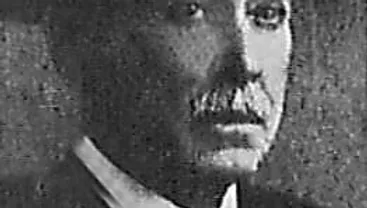
Thomas Daniel (T.D.) O’Neil, Senior was born July 5, 1867, in Pomeroy, Ohio, to John and Margaret Curtis O’Neil. T. D. and his family moved to Pittsburg, Pennsylvania, in 1889 where T.D. began working as a machinist with the Union Pacific Railroad, though only having an eighth grade education. He moved to Cheyenne, Wyoming with the Union Pacific in 1890, and soon after went in to ranching.
T.D. was widely known for wearing a suit and tie during all his ranch operations whether he was moving cattle, branding, haying, or attending cattle auctions. His demure presence and affable personality made him many friends in the community. T.D. homesteaded his first ranch, Eagle Rock, near the Colorado-Wyoming border in 1891. He was a prominent rancher, horse trader, and cattleman in the Wyoming Community until his retirement in 1951.
T.D. married Mary Ellen Searcy, a schoolteacher from Cheyenne, and had seven children: Cornelia Louise O’Neil Fear, John Curtis O’Neil, Margaret O’Neil Conwell, Thomas Daniel O’Neil Jr., Ruth O’Neil Witherspoon, Mary Kelly O’Neil Meeks, and Charles Robert (C.R.) O’Neil. The O’Neil family suffered tragedy early with John Curtis dying at only four years old of meningitis and Thomas Daniel O’Neil Jr. drowning in an unfortunate incident at just 12 years old. In a strange turn of events, none of the three boys were alive at the same time. This shaped T.D. and Mary’s life as they dealt with the losses while continuing to raise the rest of their children and build their ranching businesses.
In the late 1890s, T.D. and Mary, began their ranching career raising and selling horses in Cheyenne. In 1904, T.D. bought the N.R. Davis horse ranch, the Lazy D, operating in Wyoming and Colorado. During this time, the Frontier committee awarded a contract to T.D. to furnish the wild horses for the bucking and pitching contests in the wild horse races. As the Lazy D ranch grew, T.D. sold horses to the government to be used in the Cavalry. T.D. had over 500 head of horses that he raised and cared for on the Lazy D.
In 1905, he sold his entire band of horses and turned from horse to cattle ranching. Both horse and cattle raising are a 24/7 operation and T.D. was in the saddle every day, caring for his livestock’s needs. In 1907, he sold the ranch to Warren Livestock Company.
T.D. had a few stints with fame. The following article was in the Wyoming Tribune, on February 9, 1906: “Late yesterday afternoon Dr. J.H. Conway was summoned to the Davis ranch south of town to attend to a serious bullet wound received by Tom O’Neill, now owner of the ranch. O’Neill was shot from ambush yesterday afternoon while repairing fences, six miles of which were torn down by some unknown foe the previous night. The scene of the shooting was some distance from the ranch house. While O’Neill was at work he was startled by hearing a shot coming from some underbrush a considerable distance away. Four more shots were fired in quick succession, the bullets whistling all about him. One struck him in the right leg, passed through, and buried itself in the left leg. The wound was doubtless made by a 30-30 bullet fired from a considerable distance, as it had spent its force, otherwise it would have passed through both legs. Although badly crippled O’Neill managed to reach his horse and ride to his home, when he telephoned to Cheyenne for medical aid.”
The Cheyenne Daily Leader, April 30, 1909, had the following article: “Dick Abbot, a young ranchman, living near Carr, Colorado, was arrested last night by Sheriff Florance on a warrant sworn out by Tom O’Neil of Cheyenne, on charges of horse stealing. O’Neill, a wealthy ranchman, pastures his stock on the bluffs in the vicinity of Carr and within six months a number of his best horses have disappeared. He started out to hunt his horses, thinking they had strayed, and as he passed Abbott’s ranch saw one of his best saddle horses in the barn, identified it, and the arrest of Abbott followed.”
In 1909, T.D. moved to Big Piney purchasing several ranches, including the Allen place, the Johnson-Bentley, the Rich and Birch places. Together, these purchases created T.D.’s legacy ranch, Cottonwood, a Hereford ranch.
T.D.’s favorite time of year was spring, when it was time to brand. He would get up earlier than everyone else, put on his suit and tie, and head to the corral to catch and saddle his favorite horse, Big Red. During the rest of the day his strong voice would boom over all the crew gathering the cattle. Once the calves were separated and ready for branding, he was always the one to brand the calves. No one worked harder than he did.
He loved horses and taught all those around him to respect and treat them with care. He taught his grandson, Tom O’Neil, how to properly break and train a horse. They spent hours in the corral working with the horses. You could say they were the forerunner to the “Horse Whisperer.” Tom was known for his gentleness in breaking horses and broke horses for many people in Sublette County because of his grandfather’s influence. He was a strong supporter of 4-H and FFA and enjoyed mentoring the area youth.
T.D. knew horses as well as any good horseman. When his son Bob bought a beautiful Arabian stallion he said, “Son, that horse is too small to ever be a good cattle horse,” but Bob proved him wrong. Suhyan turned out to be the most intelligent roping and cattle horse on the ranch. He had more endurance than any of the other horses, and morning to night, he gave it his all. T.D. had to eat his words and became a full supporter of Arabians, even riding Suhyan a few times.
He looked forward to moving cattle up to the Wyoming Range in the spring. He could really crack the whip getting the cattle to move out or to get the attention of a crew member to go get a calf that had strayed from the herd. If a calf was born on the trail, he would often be seen carrying it across his saddle, speaking softly to it as they traveled the rocky terrain. At any time he could tell you where a cow or calf was. Once the herd arrived at their destination, he wanted all the cows and calves to be “mothered up,” making sure each mom had her calf, before the day ended.
Every fall T.D. saddled up and rode in the cattle drive moving his herd from Big Piney to Opal, to be delivered to buyers who would transport them on trains to market. The drive was a long, strenuous 80-mile trail and T.D. and two other cowhands would direct the herd on horseback for the six-day journey. The length of the journey depended on the weather which sometimes dipped to 50 degrees below zero. They stayed at various ranches along the trail where hospitable ranchers would bunk and feed the hands and horses for the night. The rancher wives would deliver meals to the drivers along the way.
The first stop was the Fear ranch in Big Piney which was owned by his daughter Cornelia and her husband. They also stayed at the Yost ranch, Sims ranch, and Polson’s ranch on the Fontenelle. The last night was spent on Craven Creek, five miles north of Opal, where they worked the cattle prior to delivering them to the buyers. The last day was only a five mile drive but was the most difficult day of the six-day trek due to the difficult terrain. Once they arrived at Opal, the cattle were weighed and handed over to the buyers to be loaded on trains for the Eastern market. The ranchers were paid for the cattle on the spot and oftentimes only made enough to pay their expenses for the past year.
Once relieved of their cattle duties, the cattle driver’s stayed at the Opal Town Mercantile and Hotel and had a hot meal and bath before heading back to Cottonwood. The ride back took two to three days depending on weather and the stops they made along the way. In later years, when it became more difficult for T.D. to ride a horse, he would travel behind the herd, when possible, in his car, never wanting to let go of being a true cowboy.
T.D. was known as a forerunner of the cattle industry. In 1921, as a close student of the market, his insight allowed him to weather a financial storm as the cattle industry took a turn. He saw the cattle market was starting to shift. Knowing this, he changed his strategy by moving his cattle to the mid-western states to feed and fatten and then selling smaller herds to buyers. In 1927 he found that his strategy allowed him to take a turn for the better. Ultimately the markets stabilized and his ranch continued to thrive.
In 1932, he sought and won the Democratic nomination for Governor. Many note that T.D. ran and was backed because he was not a part of machine politics. He stood for every man and was willing to challenge the political system. He cited his backing by the Wyoming Stock Growers, experience as Chairman of Lincoln County Commissioners, a member of the State Highway Commission, and a long-time businessman, rancher, and cowboy in Wyoming, for his campaign. T.D. was also a founding and lifetime member of the Knights of Columbus Cheyenne Branch 801, a lifetime member of the Wyoming Stock Growers, and a Director of the First National Bank of Kemmerer. It was a close election. Even though he lost, it elevated him to a place of eminence in his party.
A fun tidbit about T.D. is the fact that he was quite proud of his sheep herd. Yes, sheep herd. T.D. loved mutton and lamb, and was somewhat embarrassed by this fact because he was a solid cattle rancher. He kept his sheep herd in the remote area of his ranch hoping no one knew he had them.
His spirit was always — you are here for your animals, not the animals here for you. He loved teaching others what it takes to live the cowboy way of life which he always imparted to his family. His cows and horses were his life. He loved the land where he ranched and always strived to improve it for his stock and for his family that followed him into ranching.
The last few years before he died, T.D. and Mary lived in Cottonwood Canyon outside of Salt Lake City, Utah. This is where T.D. died on February 23, 1955. His loving wife, Mary Ellen, died September 12, 1960. T.D. and Mary left their footprints on the state of Wyoming in deep ways, and they were ever grateful for the support and opportunity presented to them by the great state of Wyoming.